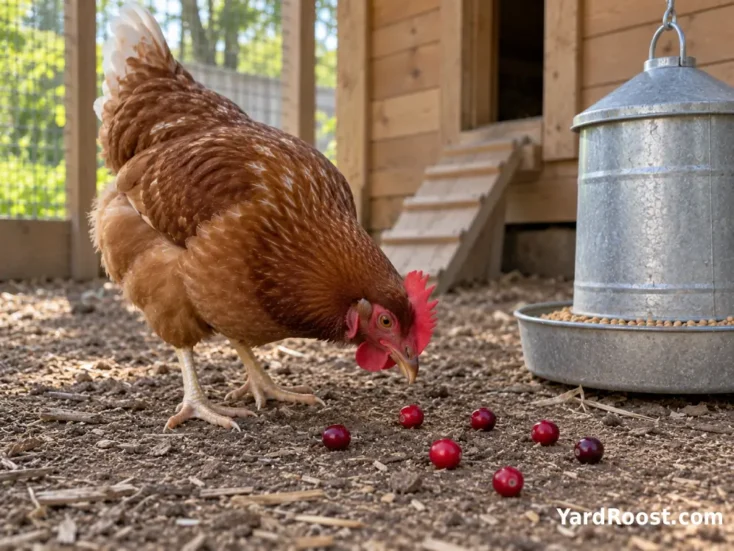
Yes, chickens can eat plain cranberries as an occasional treat. For an adult backyard flock, fresh cranberries are the simplest choice: serve them plain, offer only a modest amount, and keep the flock’s complete feed as the foundation of the diet.
The bigger question is not whether chickens can have cranberries, but what form you are feeding. Fresh berries are quite different from sweetened dried cranberries, cranberry sauce, juice cocktails, or holiday leftovers loaded with sugar and other ingredients. Those processed versions are either less useful as treats or better left out of the run entirely.
Cranberries also do not need to be treated as a supplement or flock-health remedy. A few berries can provide variety and encourage natural pecking behavior, but they should not displace a nutritionally complete ration. University of Maryland Extension and Penn State Extension both emphasize the importance of complete poultry feed and caution against allowing excessive scraps or extras to dilute a balanced diet.
Here is how we would handle cranberries in a small backyard flock.
Can Chickens Eat Cranberries? The Short Answer
For healthy adult chickens, a small serving of plain fresh cranberries can fit alongside other occasional produce treats. There is no need to cook the fruit, add sugar, or prepare a special cranberry mixture.
Some hens will peck at the berries immediately. Others may ignore a whole cranberry because it is unfamiliar or because the tart fruit simply does not appeal to them. That is normal. Chickens have individual food preferences, and there is no nutritional reason to persuade a reluctant bird to eat cranberries.
Keep the distinction between a treat and a ration clear. A complete poultry feed is formulated to provide the nutrients chickens need for their age and stage of production. Fruit is an extra. University of Minnesota Extension similarly advises that treats should not replace a balanced ration.
If you are building a sensible treat routine for a new flock, our guide to safe chicks treats is a useful place to start.
Fresh Cranberries Are the Simplest Option
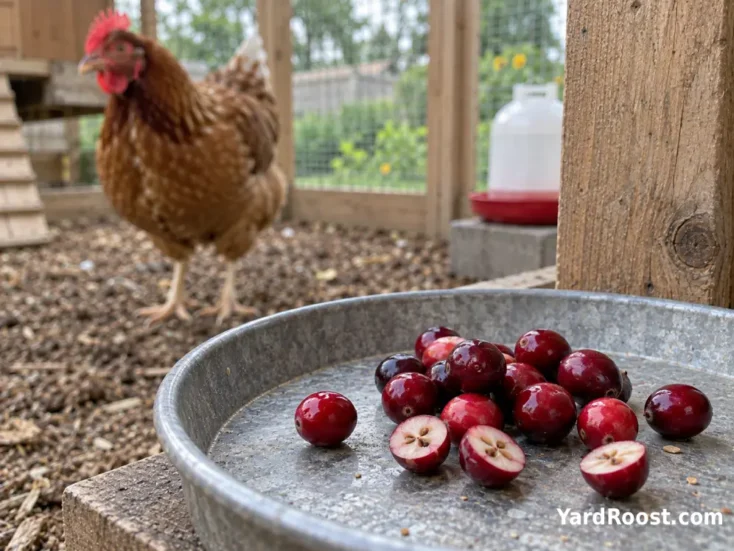
Fresh, washed, unseasoned cranberries are the version we would choose first. You can toss a few into the run whole, but halving or roughly chopping them can make an unfamiliar fruit easier for chickens to investigate and reduces the chance that one enthusiastic bird carries off most of the treat.
There is no need for elaborate preparation:
- Rinse off visible dirt or debris.
- Discard fruit that is moldy, rotten, or badly spoiled.
- Serve the berries plain, without sugar, syrup, salt, or seasoning.
- Scatter a modest amount so several hens get a chance to peck.
- Remove leftovers rather than letting fruit sit in the run for days.
YardRoost editorial note: A common beginner mistake is turning a healthy-looking ingredient into an unnecessarily complicated flock snack. Cranberries do not become better chicken food when mixed with oatmeal, syrup, supplements, or a dozen other treats. Plain and simple is easier to portion and easier on the overall diet.
Chickens swallow food without chewing it with teeth; the crop temporarily holds feed before it moves through the digestive system. That does not mean every large food item should automatically be served whole. For backyard keepers, cutting unfamiliar produce into manageable pieces is an easy way to reduce waste and see whether the flock actually likes it. University of Maryland Extension describes this crop-and-gizzard digestive process in its backyard poultry guidance.
Can Chickens Eat Dried Cranberries?
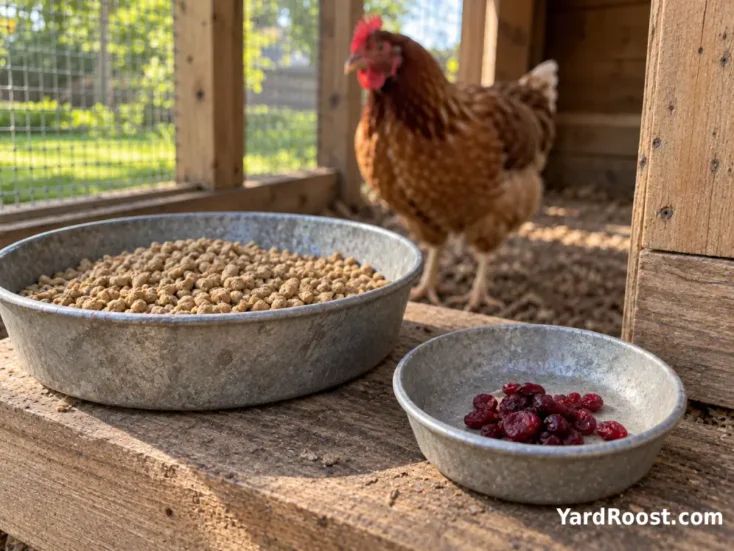
Chickens can have dried cranberries in small amounts, but the ingredient label matters more here than it does with fresh fruit.
Many dried cranberry products are sweetened. Drying also removes much of the water from the fruit, so it is easy to hand out a larger amount than you intended. For routine backyard feeding, unsweetened dried cranberries are the better choice when you can find them. Sweetened versions are unnecessary and are best skipped rather than turned into a regular flock snack.
Check the package before sharing dried fruit. We would avoid products that are:
- heavily sweetened or candy-like
- covered in chocolate or other coatings
- part of a seasoned or salty snack mix
- moldy, damp, rancid-smelling, or otherwise spoiled
You also do not need to buy dried cranberries specifically for your chickens. If you already have an appropriate plain version in the pantry, a few pieces can be an occasional treat. Otherwise, complete feed should get the feed-budget priority. For more on that distinction, see our chicken layer feed basics.
Fresh, Dried, Sauce, Or Juice: What Should You Offer?
The closer a cranberry is to its plain fruit form, the easier the decision usually becomes. Processed cranberry foods tend to bring along ingredients your chickens neither need nor benefit from.
| Cranberry Food | Backyard Flock Guidance | Why |
|---|---|---|
| Fresh cranberries | Fine as an occasional treat | Simple, plain fruit with no added ingredients |
| Unsweetened dried cranberries | Offer sparingly | More concentrated and easy to overfeed |
| Sweetened dried cranberries | Better to skip | Added sugar provides no useful reason to choose them |
| Cranberry sauce | Skip | Usually contains substantial added sugar and may contain other ingredients |
| Cranberry juice or juice cocktail | Skip as a routine treat | Clean drinking water should remain the flock’s normal beverage |
Homemade cranberry sauce is not automatically a better choice. Even if every ingredient is familiar, the sauce is usually designed for human taste rather than poultry nutrition. It may contain sugar, sweeteners, citrus, spices, or other additions. There is no practical advantage to sorting through a holiday recipe when a few plain berries are easier.
The same applies to cranberry juice. Do not replace or flavor the flock’s drinking water with it. Reliable access to clean water is a basic poultry-management priority, and fruit juice adds nothing chickens need from their waterer. Penn State Extension and University of Maryland Extension both emphasize maintaining appropriate complete feed and reliable fresh water for backyard flocks.
How Much Cranberry Should Chickens Get?
There is no special cranberry serving requirement for chickens. The useful rule is simpler: keep fruit clearly in the treat category and make sure it is not competing with the flock’s complete ration.
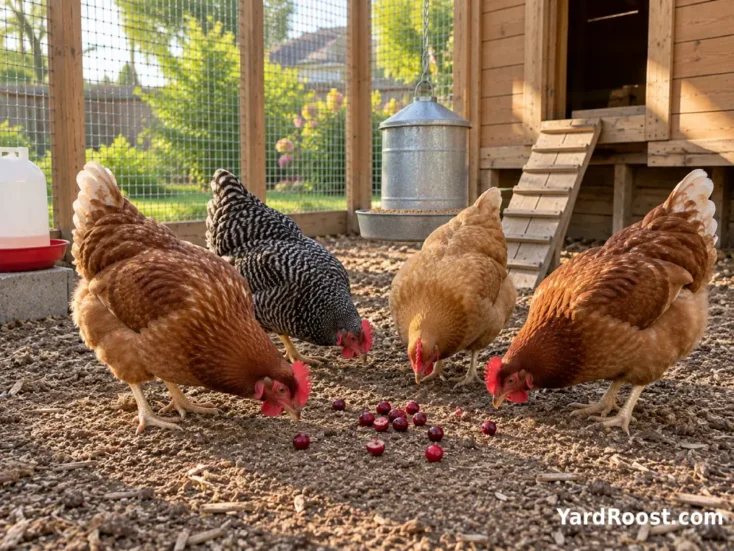
For a small backyard flock, we would start with a small handful scattered among several adult birds rather than putting down a bowl full of berries. If the chickens finish their normal feed and the cranberries disappear quickly, that tells you the portion was manageable. If fruit is being left on the ground, you offered more than the flock wanted.
University of Maryland Extension describes table scraps as treats and advises against excessive amounts; one practical rule in its feeding guidance is to limit scraps to what birds can consume in a short feeding period. Penn State Extension likewise cautions against high levels of human food because complete feed should remain nutritionally dominant.
Three useful checks are:
- Look at the feeder first: chickens should not be filling up on fruit while ignoring their balanced ration.
- Watch the ground afterward: uneaten berries should not remain scattered around the run.
- Keep treats occasional: cranberry day does not need to become a daily feeding routine.
Young chicks deserve extra caution. Their correctly formulated starter ration should be the priority while they are growing, so there is little reason to introduce sugary or bulky extras simply for variety.
Common Cranberry Feeding Mistakes To Avoid
Cranberries are straightforward to feed, but a few common habits can turn a simple treat into unnecessary mess or nutritional competition.
- Giving a large bowl at once: more is not better. Start small and let complete feed do the nutritional heavy lifting.
- Assuming dried means healthier: check the label. Dried cranberries are commonly sold sweetened.
- Sharing cranberry sauce from the table: plain berries are much easier to evaluate than a multi-ingredient recipe.
- Leaving leftovers overnight: remove uneaten fruit rather than allowing it to spoil or attract wildlife.
- Using cranberries as a health supplement: they are a treat, not a treatment for illness or a replacement for appropriate poultry nutrition.
YardRoost editorial note: Treats often creep upward without the keeper noticing. A handful of fruit in the morning, scratch later, and kitchen scraps after dinner can add up to a surprisingly large share of the day’s food. Looking at all extras together is more useful than judging the cranberries in isolation.
If several birds consistently ignore their normal feed, lose interest in food, or show other signs that concern you, do not try to solve the problem by offering increasingly tempting treats. That is a flock-management or health question, not a cranberry problem.
Clean Up Leftovers So You Do Not Feed Wildlife Too
Your chickens may not be the only backyard animals interested in fruit. Wild birds, squirrels, rodents, and other wildlife can investigate food left around a poultry area. That makes cleanup a biosecurity issue as well as a housekeeping habit.
USDA APHIS specifically recommends reducing access to food sources around poultry, cleaning up spilled or uneaten feed, and limiting opportunities for wild birds and rodents to visit flock areas. Its wildlife-management guidance also identifies fallen fruit and berries as potential wildlife attractants.
After offering cranberries, take a look at the run later that day. Remove berries that have been ignored, especially before they become soft or spoiled. You do not need to scrub the ground after every treat; the useful habit is simply not leaving a recurring food source outside for wildlife.
This matters even more if you already see wild birds around the feeder or evidence of rodents near the coop. USDA’s Defend the Flock program recommends protecting poultry feed from contamination and reducing contact between backyard flocks and wild birds.
When To Call An Avian Vet
A chicken taking one peck at a cranberry and walking away is not a medical concern. A bird becoming visibly unwell is different.
Contact an avian or poultry veterinarian, or your local extension office, if a chicken develops concerning signs such as pronounced weakness, trouble breathing, persistent refusal to eat or drink, or a crop that remains unusually full and firm first thing in the morning before the bird has eaten. University of Maryland Extension notes that a normal crop is generally empty and difficult to locate at that time of day, while an abnormally persistent full or firm crop may signal a problem that deserves attention.
Do not assume cranberries caused a health problem simply because a bird recently ate them. Many conditions can produce vague signs in poultry, and diagnosing the cause from a single food exposure is unreliable. Remove unfamiliar treats, provide the flock’s normal complete feed and clean water, observe the affected bird closely, and seek qualified guidance when signs are significant or persistent.
The Bottom Line On Cranberries For Chickens
So, can chickens eat cranberries? Yes. Plain fresh cranberries can be a perfectly reasonable occasional treat for an adult backyard flock, and a small amount of unsweetened dried cranberry can work too.
Fresh is the easiest option because you can see exactly what you are feeding. With dried fruit, check for added sugar. Cranberry sauce, juice cocktails, candy-coated fruit, and complicated holiday leftovers do not offer an advantage over plain berries and are better skipped.
Most importantly, keep cranberries in perspective. They are a little variety for the run, not an important part of poultry nutrition and not a remedy for health problems. Let complete feed remain the main diet, start with a modest serving, and remove leftovers before wild birds or rodents find them.
That simple routine works well for most small flocks: plain food, small portions, a quick cleanup afterward, and no pressure if your hens decide cranberries are not nearly as exciting as you expected.