The Black Copper Marans is best known for laying richly colored reddish-brown eggs, but there is more to this French breed than its attractive egg basket. These are substantial, dual-purpose chickens with black plumage, copper accents, lightly feathered legs, and enough individual personality to keep a small flock interesting.
The term black copper maran is common online, but the formal breed name is Black Copper Marans. The final “s” is used whether you are describing one chicken or an entire flock. You may also see birds advertised as French Black Copper Marans, French Copper Marans, or Copper Black Marans. Those labels do not automatically guarantee darker eggs, better temperament, or show-quality breeding.
For a beginner, the main questions are practical: How dark will the eggs really be? Can chicks be sexed early? Are the roosters manageable? Will the breed fit comfortably in a suburban flock? This guide separates dependable breed traits from seller promises so you can decide whether Black Copper Marans belong in your coop.
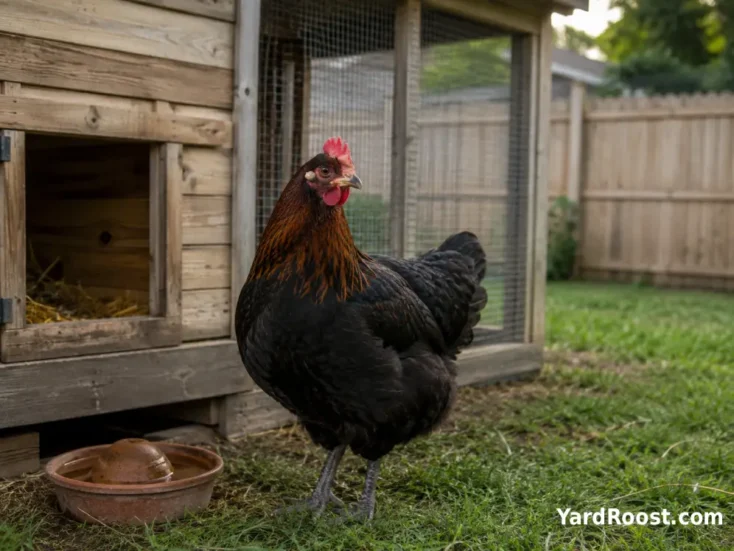
What Is a Black Copper Marans Chicken?
Marans chickens originated in France near the Atlantic port town of Marans. The modern breed was shown in France during the early 1900s, and the Marans Club of France established its first breed standard in 1931. In the United States, the Black Copper variety received American Poultry Association approval in 2011.
It is a general-purpose breed rather than a specialized commercial egg layer. The American standard describes mature males at about 8 pounds and hens at about 6.5 pounds, although individual backyard birds may fall above or below those target weights. Their rectangular, broad-bodied build feels sturdy without being as heavily feathered as a Cochin or Brahma.
| Trait | What to Expect |
|---|---|
| Origin | France, near the town of Marans |
| Primary Use | General-purpose breed for eggs and meat |
| Egg Color | Reddish brown to deep chocolate-russet |
| Comb | Single comb |
| Legs | Light feathering along the outer shanks and toes |
| Adult Size | Large-fowl size; standard hens about 6.5 pounds and males about 8 pounds |
| Chick Sexing | Not reliably determined from down color alone |
One important distinction involves the legs. The American standard follows the French type and calls for light feathering on the outer shanks and toes. Clean-legged birds have existed in English-type flocks, but the absence of shank feathering does not match the current American standard.
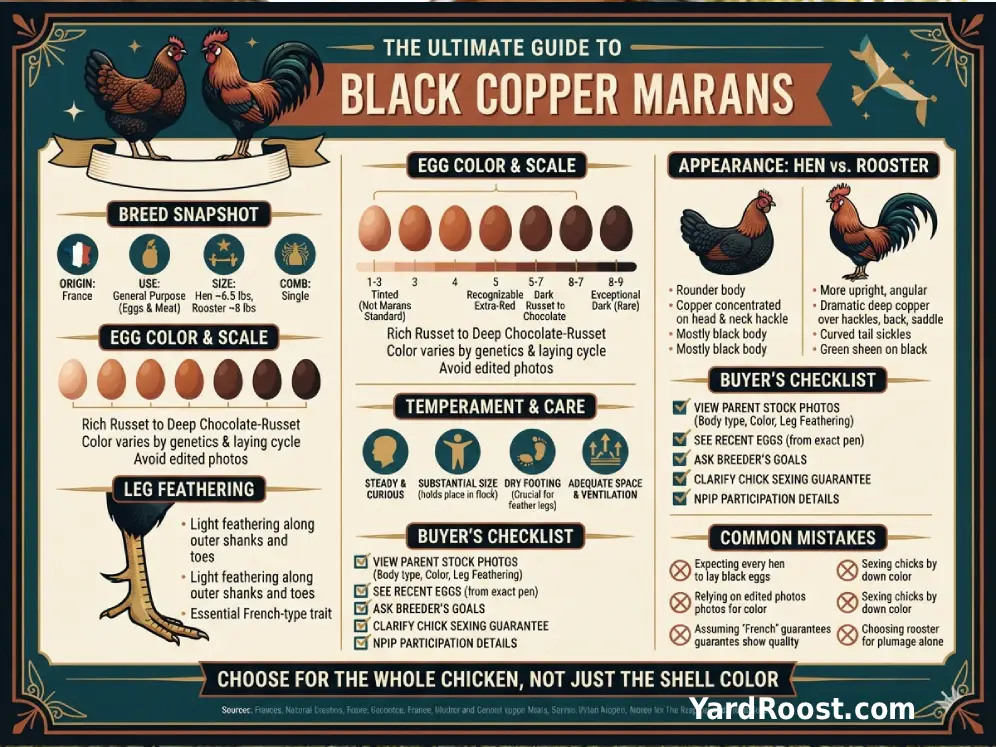
Black Copper Marans Color and Breed Appearance
A well-colored Black Copper Marans is not simply a black chicken with random orange feathers. The breed standard calls for a deliberate balance of lustrous black and deep copper.
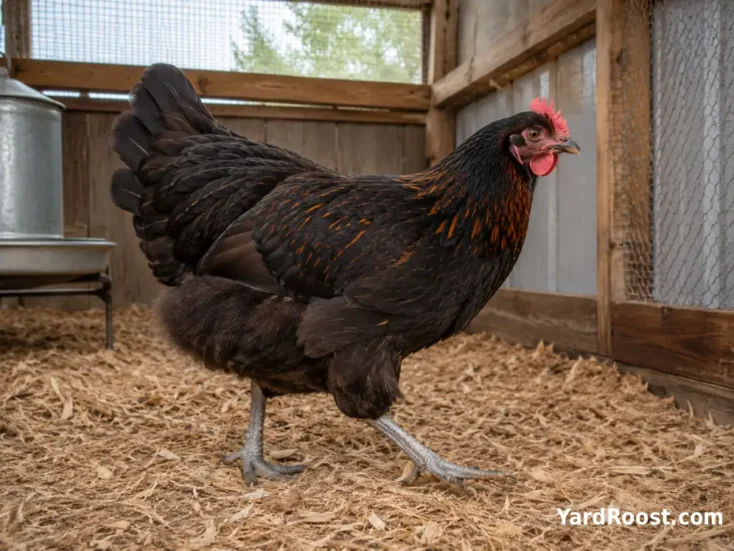
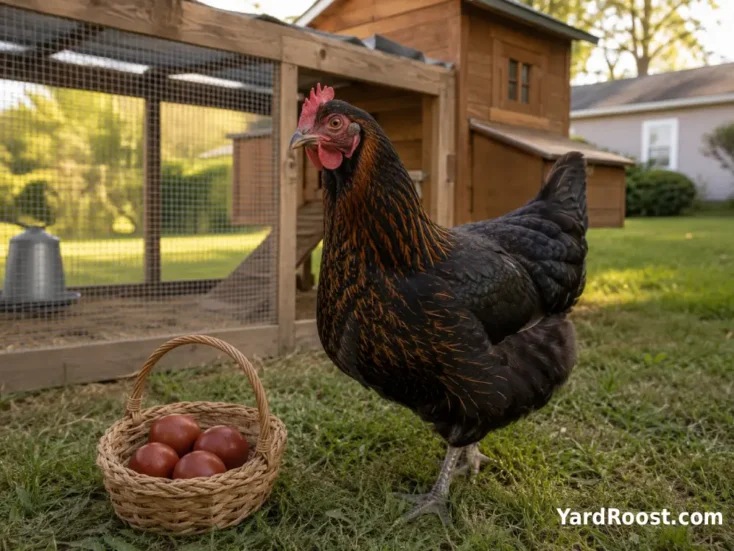
A hen should have a mostly black body, tail, wings, and breast. Copper is concentrated around the head and neck hackles, often with a narrow dark stripe through each copper feather. A few copper marks on the breast may be acceptable, but heavy breast lacing is not the goal. Her slate-colored legs should carry light black feathering along the outer shank and toe.
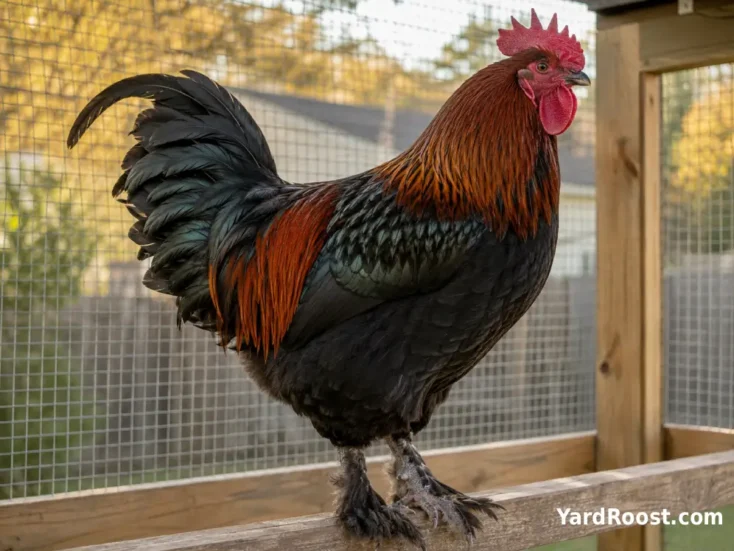
The rooster is more dramatic. He normally develops deep copper through the head, hackles, back, and saddle, with black breast, body, and tail feathers. The black plumage may show a greenish sheen in natural light. The recognized copper is deep and rich rather than pale yellow or very dark mahogany.
Backyard-quality birds often fall short of exhibition color. Some hens have very little visible copper, while others carry too much reddish color across the breast. Roosters may develop pale straw-colored hackles, excessive red, white feathers, or uneven wing color. These variations usually matter more to exhibitors and breeders than to keepers who simply want healthy birds and attractive eggs.
The practical point is to decide what you are buying. A hatchery-quality bird can be a perfectly good flock member without matching every show detail. A breeder charging a premium for standard-bred stock should be able to explain how the parents compare with the recognized body, leg-feathering, and color requirements.
What Color Are Black Copper Marans Eggs?
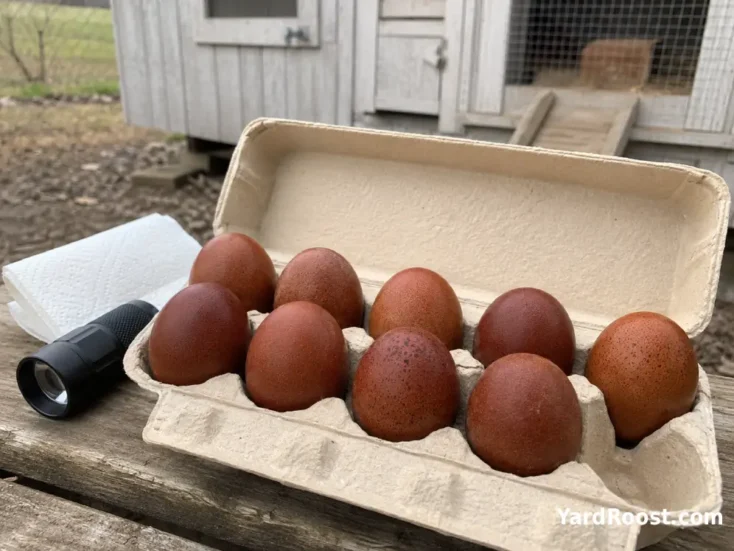
Black Copper Marans eggs can range from a warm russet brown to a very dark red-brown commonly described as chocolate. Some shells are evenly colored, while others are speckled, stippled, or covered with darker patches. The recognized breed ideal emphasizes a deep reddish-brown shell, but not every hen produces the darkest possible shade.
The Marans Club of France uses a physical egg color scale numbered from 1 to 9. On that chart, the lower numbers represent white, tinted, or relatively light red-brown shells. Level 4 is the first clearly breed-typical extra-red color, levels 5 through 7 become progressively darker, and levels 8 and 9 represent exceptional, uncommon eggs.
| French Chart Range | Practical Description |
|---|---|
| 1–2 | White or lightly tinted; not representative of Marans egg color |
| 3 | Reddish but lighter than the preferred breed character |
| 4 | Recognizable extra-red Marans color |
| 5–7 | Increasingly dark russet, red-brown, or chocolate shades |
| 8–9 | Exceptionally dark and rarely produced consistently |
Use a printed, standardized chart under natural light when comparing eggs. Phone cameras, editing filters, indoor bulbs, and computer screens can make an ordinary brown egg appear much darker or redder than it is.
Egg color is strongly tied to genetics. Special feed ingredients cannot turn a pale-brown laying line into a reliably dark-egg line. Color can also change within a hen’s laying cycle; the French club notes that eggs may be somewhat darker near the beginning of a cycle. A hen that lays a striking first egg may therefore produce lighter eggs later without anything being wrong.
Dark shells also do not make the contents automatically more nutritious. Feed quality, hen health, freshness, and handling matter more to the edible egg than shell color alone.
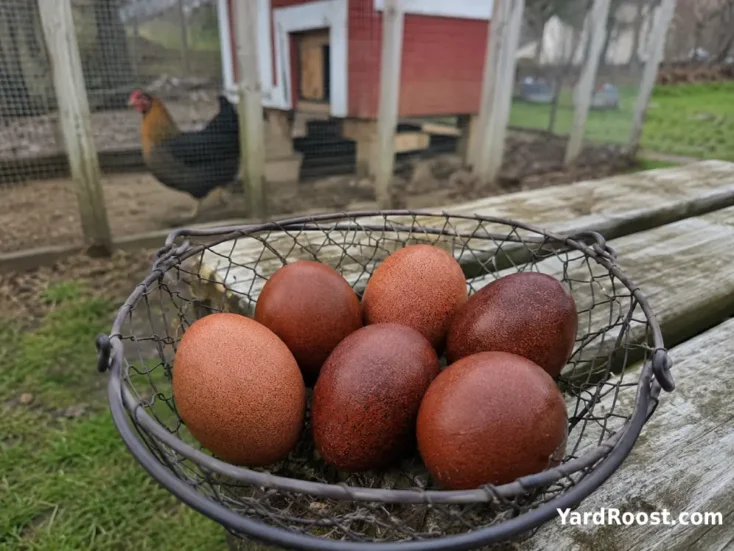
Black Copper Marans Egg Production Without the Sales Hype
Black Copper Marans are better viewed as moderate, general-purpose layers than as maximum-production chickens. The breed standard emphasizes both eggs and body qualities rather than the very high output associated with specialized commercial hybrids.
Actual production varies considerably among breeding lines. A flock selected heavily for exhibition appearance may not perform like one selected for steady laying. A breeder concentrating on extremely dark shells may make different selection decisions than a hatchery supplying general backyard stock.
Before buying, ask for realistic information from the exact breeding pen:
- How many eggs do the hens typically lay during an ordinary week in their active season?
- How does shell color change as the laying cycle continues?
- Are egg photos recent and from the parents of the chicks being sold?
- Has the breeder selected for production as well as appearance and shell color?
Be skeptical of universal annual egg totals. Age, seasonal daylight, molt, nutrition, stress, health, and genetics all affect the number of eggs collected. A responsible seller should describe a range or flock pattern rather than promise that every pullet will reach the same number.
For a small flock, a few darker eggs mixed with blue, green, cream, and lighter-brown shells may be more satisfying than chasing an extreme color score. A hen that lays slightly lighter eggs but remains healthy, productive, and easy to manage can be more useful than a costly bird selected for one visual trait.
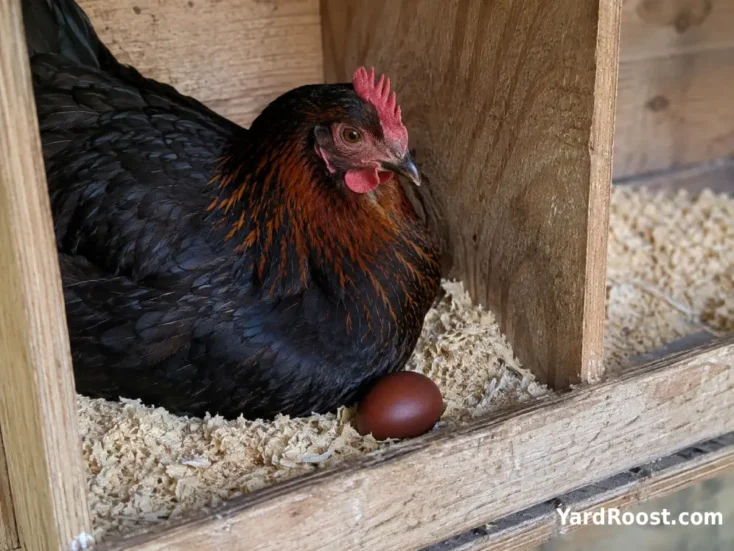
Temperament and Mixed-Flock Compatibility
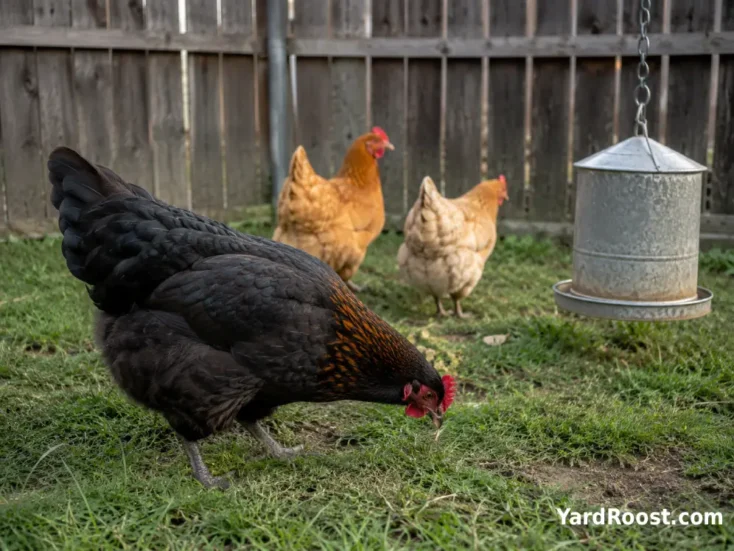
Many backyard keepers describe Black Copper Marans hens as steady, curious, or somewhat reserved. Some become comfortable around people and follow the feed scoop closely; others prefer to keep a little distance. Breed labels offer a useful starting point, but handling, breeder selection, flock dynamics, and the bird’s individual temperament matter just as much.
Their substantial body size can help them hold a reasonable place in a mixed flock. Even so, a quiet Marans pullet may be pushed away from feeders by more assertive hens. During introductions, provide more than one feeding and watering point and watch where each bird sleeps. A bird that repeatedly waits until everyone else finishes eating needs management help, not simply more time to “work it out.”
A Black Copper Marans rooster can be attentive and manageable, but no breed guarantees a gentle male. Rooster temperament may change with maturity, breeding season, confinement, or flock pressure. Avoid keeping a rooster solely because he has excellent color or comes from dark eggs. Human-directed charging, repeated flogging attempts, cornering, or stalking should be treated as serious management concerns.
Roosters also create noise and legal considerations. Check local ordinances, zoning rules, and HOA restrictions before raising straight-run Black Copper Marans chicks. Planning for unwanted cockerels after they begin crowing is far more difficult than making that decision before ordering.
For more help balancing personality, size, and egg color, see our guide to choosing top egg laying chicken breeds.
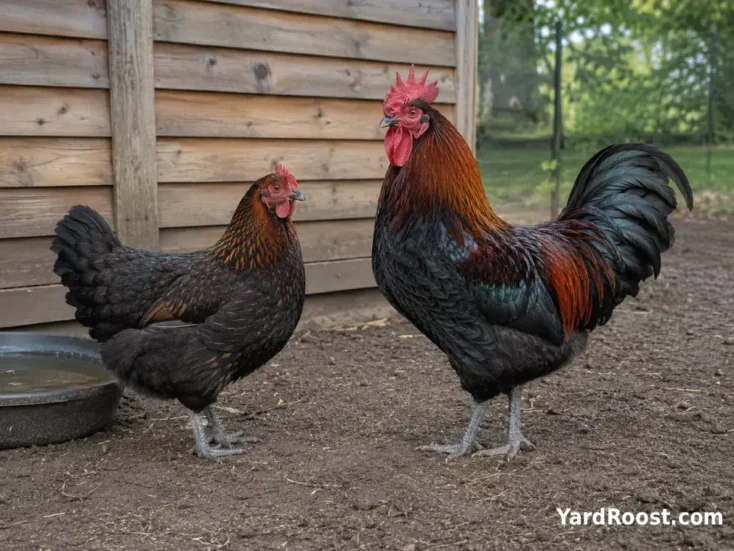
Black Copper Marans Hen Versus Rooster
Adult birds are usually straightforward to distinguish. Roosters are larger, taller, and more angular, with prominent combs and wattles. Their copper color extends across the hackles, back, and pointed saddle feathers. Mature males also develop curved tail sickles and longer, narrower hackle feathers.
Hens have rounder bodies, smaller combs, and shorter tail feathers. Their copper is usually concentrated around the head and neck, while most of the back, wings, breast, and tail remain black. The American standard calls for a broad, deep body in both sexes, with the hen appearing more rounded.
Young birds require more patience. Use several clues together rather than declaring a chick male because it has thick legs or stands upright.
- At about 4 weeks, an early-growing red comb may suggest a cockerel, but individual development overlaps.
- Around 8 to 12 weeks, cockerels may show more obvious shoulder color, larger wattles, and a more upright frame.
- By roughly 3 to 5 months, pointed saddle feathers, longer hackles, crowing, and male tail development are stronger evidence.
- Pullets usually retain rounded feather tips and a less dramatic copper pattern as they mature.
A 3-month-old Black Copper Marans rooster may still look awkward and incomplete. A 5-month-old male is more likely to show recognizable saddle and tail feathers, but late-developing birds can still surprise a keeper. Do not base permanent flock decisions on a single photograph or one early trait.
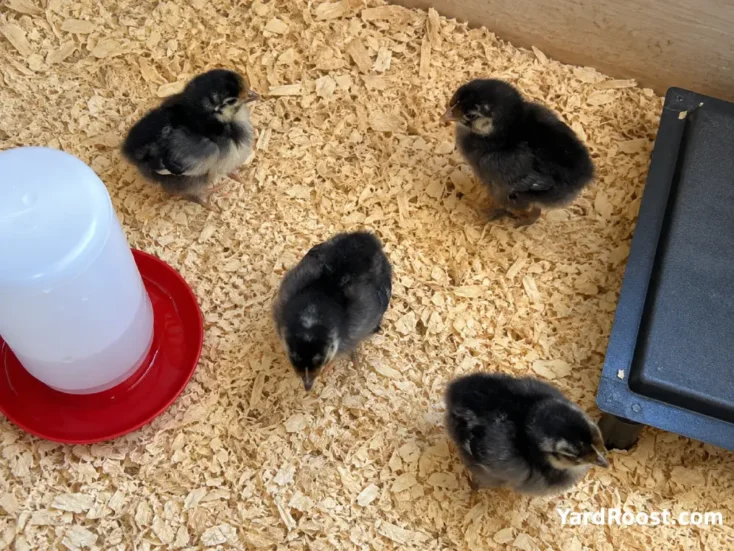
Sexing Black Copper Marans Chicks
Black Copper Marans chicks are not reliably sexed from down color alone. Chicks commonly hatch with dark down and lighter cream or yellow markings, but the exact pattern varies among lines and does not provide a dependable rooster-versus-hen answer.
Mississippi State University Extension explains that day-old vent sexing requires specialized training and that feather sexing only works when specific genetic traits have been deliberately built into a strain. Most chicken breeds do not carry the required feather-sexing combination. For a backyard owner, attempting to vent sex chicks can injure them and still produce an incorrect answer.
Advertisements for sexed female chicks should therefore be evaluated carefully. Ask the hatchery which method it uses and what accuracy guarantee applies. Some large hatcheries employ trained professionals, while small breeders commonly sell Black Copper Marans chicks as straight run.
As the chicks grow, compare them with siblings of the same age and line. Comb development, wattle color, posture, feather shape, copper distribution, and behavior become more useful together. None is completely reliable by itself at 4 weeks.
Editorial note: A common mistake we see is naming the boldest chick “the rooster” during its first week. Bold pullets and quiet cockerels are both common. Mark your suspected birds with safe leg bands, take weekly photos, and allow the evidence to accumulate.
Everyday Care for a Large, Feather-Legged Breed
Black Copper Marans do not require a specialized coop, but their body size and lightly feathered legs affect a few daily decisions. House them as full-sized chickens rather than squeezing them into a setup designed around small, lightweight hens.
Dry footing deserves particular attention. Sparse leg feathers are easier to maintain than the heavy feathering found on some breeds, yet they can still collect mud, wet bedding, or ice. After a rainy week, check whether feathers around the toes remain caked after the bird returns to the coop. Persistent mud is a drainage problem. Add a roofed dry area, redirect runoff, or replace churned soil with an appropriate well-draining surface.
Useful management checks include:
- Provide roosts broad and stable enough for a heavy hen to land without slipping.
- Keep high ventilation openings clear while preventing strong wind from blowing directly across birds at roost height.
- Use enough feeder space that slower or lower-ranking hens can eat without repeated displacement.
- Check lightly feathered feet after muddy weather rather than waiting for hardened debris to accumulate.
- Maintain shade and moving air during hot weather; a dark-feathered bird standing apart and open-mouth breathing needs prompt cooling support and close observation.
The single comb is prominent, especially on roosters. During bitter winter weather, control dampness and direct drafts rather than sealing the coop tightly. A closed, humid coop can create more trouble than cold outdoor air.
Feed Black Copper Marans according to life stage using a complete poultry ration. Darker shell color is not a reason to add unbalanced supplements or large amounts of treats. Keep treats limited enough that the birds continue eating their nutritionally complete feed.
Buying Chicks, Started Birds, or Hatching Eggs
The seller matters as much as the breed name. “French,” “show line,” “rare,” and “chocolate egg line” are marketing descriptions unless the breeder can support them with records, current photographs, and clear breeding goals.
Ask to see the parents and eggs from the exact pen producing your chicks or hatching eggs. A photograph of one unusually dark egg from several years ago tells you very little about the current flock. Useful photos show several eggs collected over time beside a recognized physical color chart under neutral light.
A responsible buying checklist includes:
- Current parent-stock photos showing body type, color, and leg feathering
- Several recent eggs from the relevant breeding pen
- A clear answer about sexed versus straight-run chicks
- The seller’s goals for egg color, production, temperament, and breed standard
- A hatch or live-arrival policy stated before payment
- National Poultry Improvement Plan participation details and the specific classifications held
The National Poultry Improvement Plan is a cooperative program involving industry, state governments, and federal officials. Participation can cover testing and sanitation standards related to specified poultry diseases, but it is not a blanket guarantee that every bird is free from every possible health problem. Ask what the seller’s particular classification means.
Hatching eggs carry additional uncertainty. Shipping vibration, temperature exposure, fertility, incubator conditions, and handling all affect results. Dark shells can also make early candling details harder to see, so a poorly visible interior should not be treated as instant proof that an egg is infertile.
Most importantly, hatching eggs do not guarantee pullets. Have a lawful, humane plan for cockerels before setting a dozen eggs.
Common Black Copper Marans Mistakes to Avoid
The breed’s popularity creates unrealistic expectations. Avoiding a few common mistakes can save money and prevent disappointment.
- Do not assume every Marans hen will lay a nearly black egg. Deep color varies by genetics and laying cycle.
- Do not use edited seller photos as an egg color chart. Compare physical eggs under consistent natural light.
- Do not assume the word French proves quality. The breed originated in France, and the American standard already calls for lightly feathered shanks.
- Do not identify a 4-week-old rooster from comb size alone. Track multiple traits over several weeks.
- Do not choose a rooster only for egg genetics or plumage. Temperament, health, structure, and flock behavior also matter.
Editorial note: The most expensive beginner mistake is buying a breed name instead of buying from a breeding program. Two sellers can offer Black Copper Marans chicks that differ substantially in egg color, body type, temperament, and productivity. Ask what each flock has actually been selected to do.
Another mistake is overlooking ordinary husbandry because the birds feel rare or special. Black Copper Marans still need the same fundamentals as other large chickens: a complete feed, dependable water, dry bedding, ventilation, predator-resistant housing, enough room to avoid chronic conflict, and prompt attention when behavior changes.
Health, Biosecurity, and When to Get Professional Help
Breed does not protect a chicken from infectious disease, parasites, injury, or nutritional problems. New Black Copper Marans should be kept physically separate from the established flock before introduction. USDA APHIS materials recommend a 30-day quarantine for new additions, with daily observation for respiratory signs, swelling, external parasites, and other health concerns.
Separation should mean more than placing a wire divider inside the same run. Use separate equipment, care for the established flock first, and avoid carrying dirty footwear, bedding, or tools between groups.
Contact an avian veterinarian, poultry veterinarian, diagnostic laboratory, or local extension office when a bird has breathing difficulty, marked lethargy, inability to stand, repeated neurological signs, significant injury, or a sudden refusal to eat and drink. Unusual illness affecting several birds or unexplained deaths should be treated as urgent. Do not try to identify or treat a potentially contagious disease from breed forums or social media photographs.
Human hygiene matters even when the flock looks clean. The CDC advises washing hands after handling poultry, eggs, or coop equipment, keeping dedicated poultry shoes outside the home, collecting eggs regularly, discarding cracked eggs, and refrigerating eggs after collection. Young children require especially close supervision around live poultry.
Black Copper Marans eggs should be handled with the same food-safety care as eggs of any other color. A darker shell is visually distinctive, but it is not a barrier against contamination.
Is a Black Copper Marans Right for Your Flock?
Black Copper Marans can be an excellent choice for a keeper who appreciates unusual egg color, substantial birds, and the challenge of watching chicks mature into distinctly different hens and roosters. They fit especially well in mixed flocks where egg-basket variety matters more than maximum production.
They are less suitable for someone expecting every hen to lay an extremely dark egg, needing guaranteed female chicks from a small breeder, or wanting the highest possible number of eggs from limited coop space. A rooster may also be impractical where local rules or close neighbors make crowing a problem.
Choose this breed for the whole chicken, not only the shell color. Look for healthy parent stock, realistic breeder records, sound temperament, useful production, correct light leg feathering, and honest explanations of what the line does well. The darkest photograph on a seller’s page should never outweigh those basics.
With sensible expectations, a Black Copper Marans hen can bring deep russet eggs, handsome plumage, and a steady presence to a backyard flock. Before ordering, measure your available space, confirm local rooster rules, and ask the seller for current information from the exact breeding pen. That preparation is far more valuable than any dramatic egg-color promise.
Sources consulted include the Marans Chicken Club USA, Marans Club of France, Mississippi State University Extension, USDA APHIS, the National Poultry Improvement Plan, and the Centers for Disease Control and Prevention.