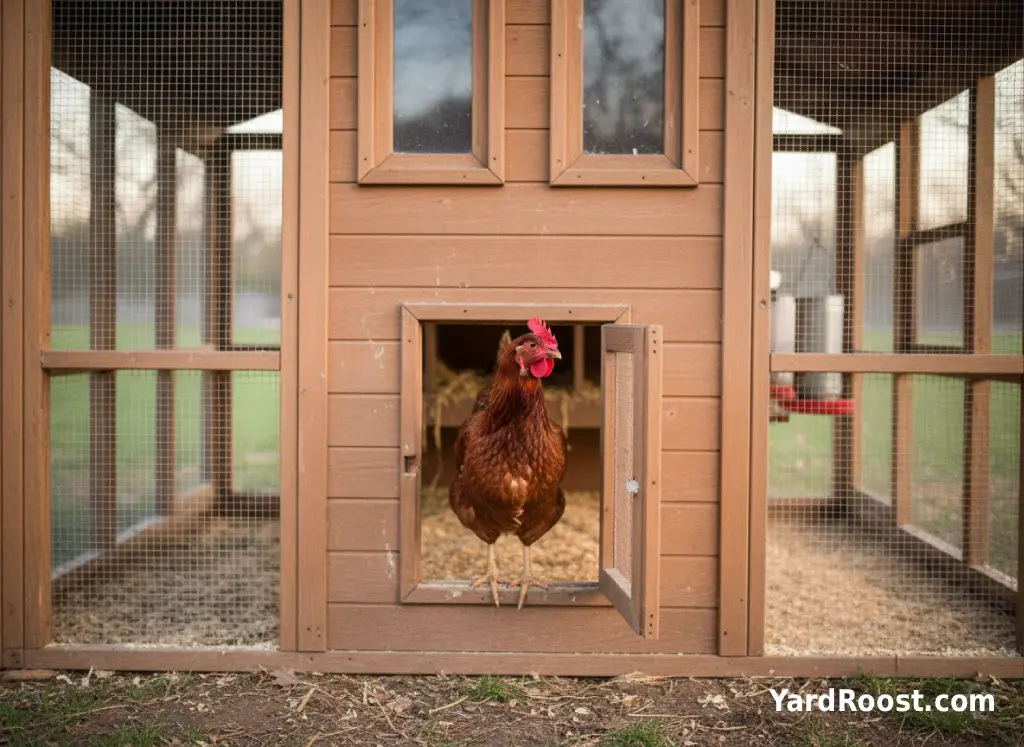
An automatic chicken coop door can make mornings easier and reduce the chance that your flock is left outside after dark. It does not replace a secure coop, good latches, or a nightly glance when something seems off, but the right door can be a practical upgrade for beginner-to-intermediate backyard chicken keepers.
For most small backyard flocks, the best automatic chicken coop door is the one that fits your actual pop-hole size, works with your power situation, gives you timer and light-sensor control, and does not add a fussy maintenance problem to your coop. Solar chicken coop door models are convenient when the panel gets reliable sun, while battery doors are often simpler for shaded coops.
Quick Picks
| Pick | Best For | Key Strength | Main Trade-Off | Check Before Buying |
|---|---|---|---|---|
| Omlet Smart Automatic Chicken Coop Door | Most backyard wooden coops | Timer, light sensor, app option, wide compatibility | Higher price tier and smaller opening than some heavy-duty doors | Wi-Fi distance, opening size, battery plan |
| Run-Chicken Eternal | Solar-powered setups | Integrated solar and rechargeable battery | Needs dependable sun exposure | Panel placement and app preference |
| Run-Chicken T50 | Simple battery-powered automation | Compact aluminum door with two AA batteries | App-based setup may not suit everyone | Pop-hole size and clearance above the door |
| ADOR1 Automatic Chicken Coop Door | Cold-weather and no-app buyers | Galvanized steel, large opening, listed -20°F low-end rating | Bulkier profile and simpler controls | Mounting height and clearance |
| ChickenGuard All-In-One Or Pro Door Kit | Flexible power and door-kit setups | Battery, DC, and solar-compatible options | More parts and setup decisions | Door weight, opener version, power accessories |
| Chickcozy Solar Automatic Chicken Coop Door | Low-clearance coops needing a horizontal door | Solar panel, rechargeable battery, center-opening design | Availability and support should be verified | Opening size, sun exposure, current model version |
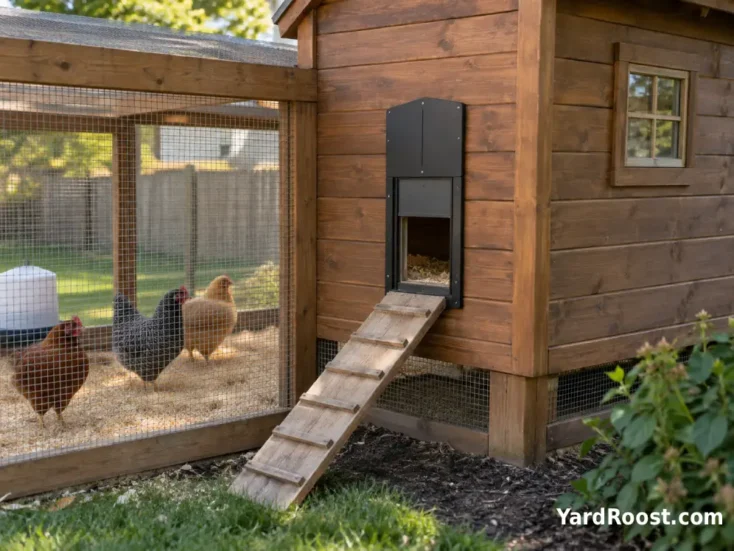
How We Chose These Automatic Coop Doors
We prioritized doors that solve real backyard problems: letting chickens out consistently, closing the coop before nighttime predator activity, fitting small wooden coops, and avoiding complicated wiring when possible. A good automatic door should be easier than your current routine, not another daily chore.
Product specs were checked against manufacturer pages where possible. For poultry-safety context, we also considered predator-management guidance from extension sources. Colorado State University Extension notes that backyard chickens are prey animals and recommends training birds to return to the chicken house and keeping it locked at night; an automatic door helps with that routine but does not make the whole coop predator-resistant by itself.
- Power source: battery, plug-in, solar, or hybrid power.
- Controls: light sensor, timer, manual override, app, or remote access.
- Opening size: large enough for standard hens and your breed mix.
- Cold-weather practicality: listed operating range, battery access, and rail-cleaning needs.
- Predator resistance: self-locking or lift-resistant design, without treating any product as a guarantee.
- Maintenance: whether dirt, shavings, ice, or mud can interfere with the track or sensor.
- Beginner fit: clear setup, replaceable batteries, understandable controls, and support.
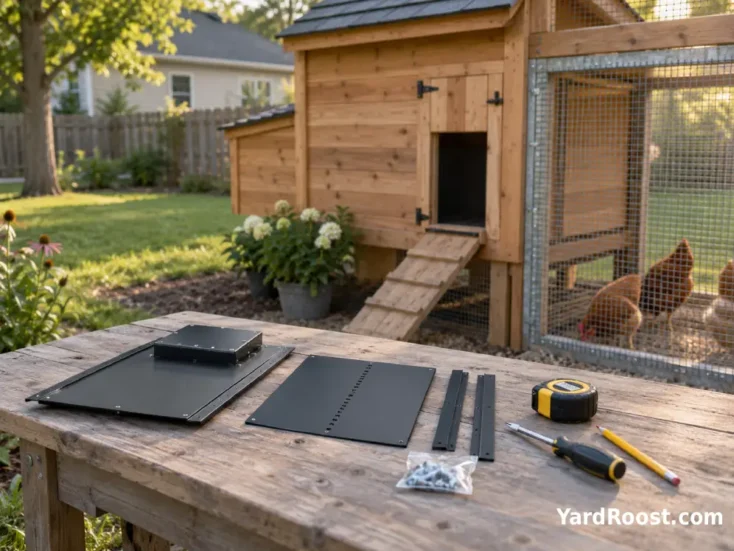
Best Overall: Omlet Smart Automatic Chicken Coop Door
The Omlet Smart Automatic Chicken Coop Door is the most balanced pick for many small backyard flocks because it combines timer control, light-sensor control, a safety sensor, battery or plug-in power, and an optional smart-control setup. Omlet lists a 6-month battery life using four AA batteries, a light sensor or timer, IPX6 waterproof casing, and a door opening of 11.75 inches high by 7.75 inches wide.
Best for: Beginner-to-intermediate chicken keepers who want a polished, widely compatible automatic door for a wooden coop, Omlet coop, or secure run panel.
Why it made the list: The feature set is strong without being too niche. The control panel can be positioned away from the door for better light readings, and the smart version can show door status, battery level, and safety sensor alerts when the coop is close enough to Wi-Fi.
- Practical upside: Good choice when you want light-sensor automation but still want timer control for cloudy evenings, shaded coops, or seasonal adjustments.
- Cold-weather note: Omlet says the door has been tested from -4°F to 150°F, but you should still keep the doorway clear of packed snow, ice, and frozen bedding.
- Main trade-off: The opening is not the largest in this guide. Large breeds, very fluffy birds, ducks, or mixed-species flocks may need a bigger pop door.
- Skip it if: Your coop is far from Wi-Fi and you mainly want a no-app, no-smart-feature door.
- Check before buying: Measure the bird opening, the full door frame, cable routing, and whether you need the plug-in cable or can manage battery replacement.
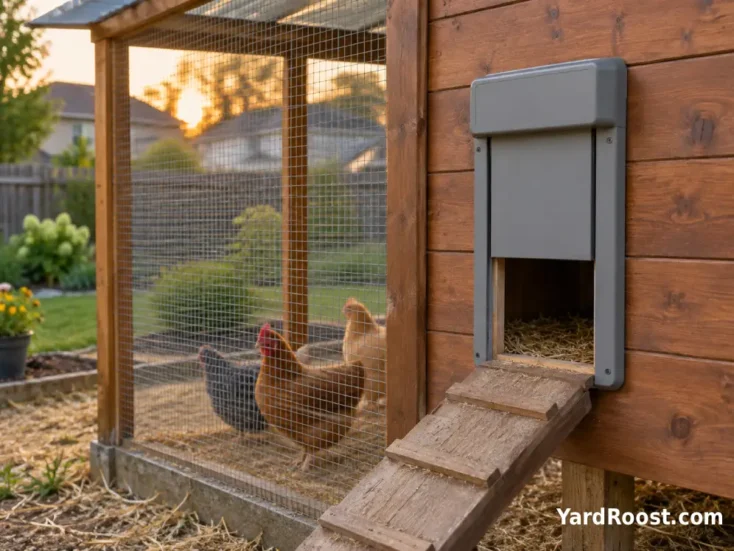
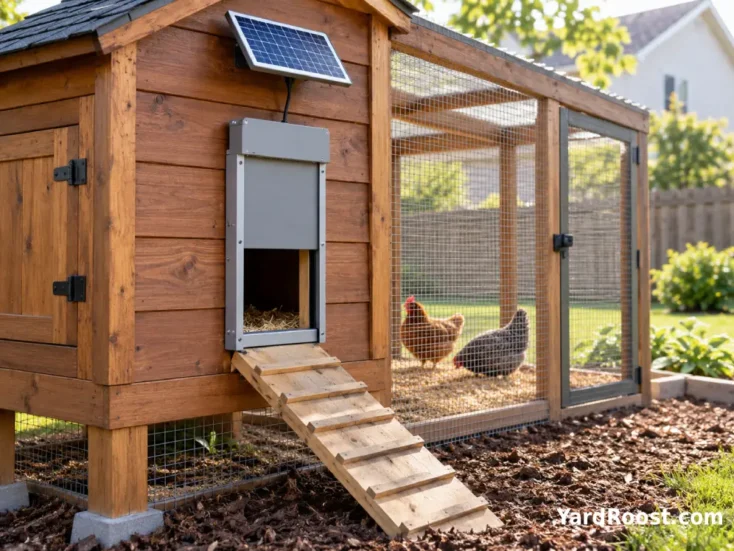
Best Solar Chicken Coop Door: Run-Chicken Eternal
The Run-Chicken Eternal is the best fit in this roundup for keepers specifically looking for a solar chicken coop door. Run-Chicken lists the Eternal as using a rechargeable battery, solar charging, Bluetooth connectivity, aluminum construction, and the same 13.8-inch by 9.4-inch by 1.6-inch body size as the T50, with a listed inner hole size of 7.9 inches by 9.8 inches.
Best for: Coops with good sun exposure where replacing disposable batteries is inconvenient.
Why it made the list: A solar powered chicken coop door is most useful when the panel gets consistent light and the coop is far from an outlet. The Eternal keeps the compact Run-Chicken format but removes the yearly AA battery routine for most owners.
- Power and controls: Integrated solar energy with rechargeable battery and Bluetooth app control.
- Practical upside: Good for mobile coops, garden coops, and backyard setups where running an extension cord would be unsafe or messy.
- Main trade-off: Solar only helps when the panel receives enough sunlight. A shaded north-facing coop, overhanging trees, or heavy snow cover can reduce charging.
- Skip it if: You do not want app-based setup or your coop sits in deep shade for much of the day.
- Check before buying: Confirm the mounting face gets direct sun, the opening suits your birds, and the app works with your phone.
Best Simple Battery Door: Run-Chicken T50
The Run-Chicken T50 is a good choice for keepers who want a compact automatic chicken coop door opener without wiring or a separate control box. Run-Chicken lists the T50 as using two AA alkaline batteries, app-based Bluetooth programming, light-sensing software, an aluminum door, and a listed size of 13.8 inches by 9.4 inches by 1.6 inches.
Best for: Small wooden coops, movable coops, and keepers who want a tidy all-in-one door.
Why it made the list: It avoids dangling strings, separate opener boxes, and complicated wiring. That makes it appealing for a first automatic door, especially if your coop already has a standard pop-hole size close to the listed inner opening.
- Practical upside: Simple physical installation compared with systems that require a separate door, pulley, or actuator.
- Main trade-off: App-based setup is convenient for some readers and annoying for others. If you prefer buttons on the control box, choose another model.
- Maintenance note: Sliding doors still need clean tracks. Bedding, mud, or ice can make any compact sliding door bind.
- Skip it if: You keep very large birds or want a larger opening for ducks, geese, or giant chicken breeds.
- Check before buying: Measure the pop-hole, confirm side and top clearance, and plan a battery-change reminder before winter.
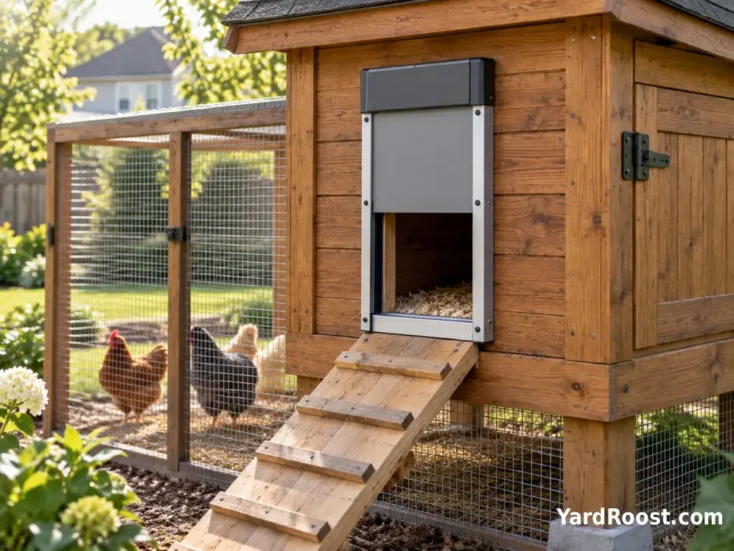
Best For Cold Weather: ADOR1 Automatic Chicken Coop Door
The ADOR1 is the strongest fit here for readers searching for the best automatic chicken coop door for cold weather, based on listed specs. AdorStore lists a 13-inch high by 10.5-inch wide opening, heavy-duty 20-gauge galvanized steel, a 6V lantern battery or optional 120V kit, and an operating temperature range of -20°F to 115°F.
Best for: Cold-climate chicken keepers who want a sturdier, no-app door with a larger opening than many compact models.
Why it made the list: The ADOR1 has a practical, utility-style design. It is less sleek than some app-connected doors, but the bigger opening and steel construction are useful for keepers who care more about function than looks.
- Practical upside: Larger listed opening than several compact doors, which can help with bigger hens or mixed-size flocks.
- Main trade-off: The overall open height is larger than the closed height, so you need enough vertical mounting space.
- Winter note: A low listed operating temperature does not mean zero maintenance. Clear ice, frozen mud, and wind-blown bedding from the opening.
- Skip it if: You want app alerts, remote status checks, or a small modern-looking door.
- Check before buying: Confirm the door has enough open-height clearance and that the battery style fits your maintenance routine.
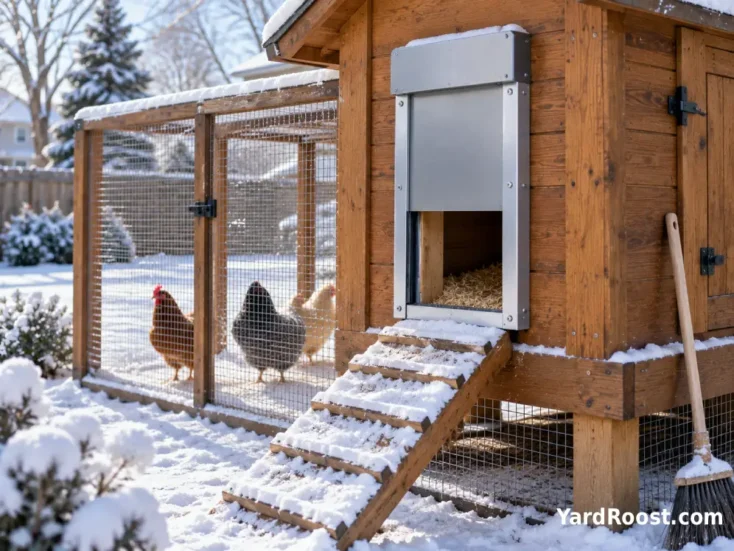
Best Flexible Door Kit: ChickenGuard All-In-One Or Pro Door Kit
ChickenGuard is a good fit when you want more flexibility than a one-piece door. The All-In-One page lists battery power with four AA alkaline batteries included, optional compatible solar or 9V DC power, auto-stop, Dual Safety timing, and operation down to -4°F and up to 140°F.
Best for: Keepers who want a self-locking door kit or a separate opener-and-door setup instead of a single molded panel.
Why it made the list: The ChickenGuard range can make sense when you already understand your coop layout and want to choose between a controller, door kit, or all-in-one setup. Its product range also lists features such as a 3-year warranty, programmable timer, light sensor, door-lift capacity, self-locking door, auto stop, winter mode, and solar options across models.
- Practical upside: More configuration choices than many compact doors.
- Main trade-off: More choices also mean more chances to buy the wrong version or miss an accessory.
- Skip it if: You want the simplest possible out-of-box installation with no separate door-kit decisions.
- Check before buying: Door weight, opener compatibility, whether solar or DC power accessories are included, and whether you need an extension kit.
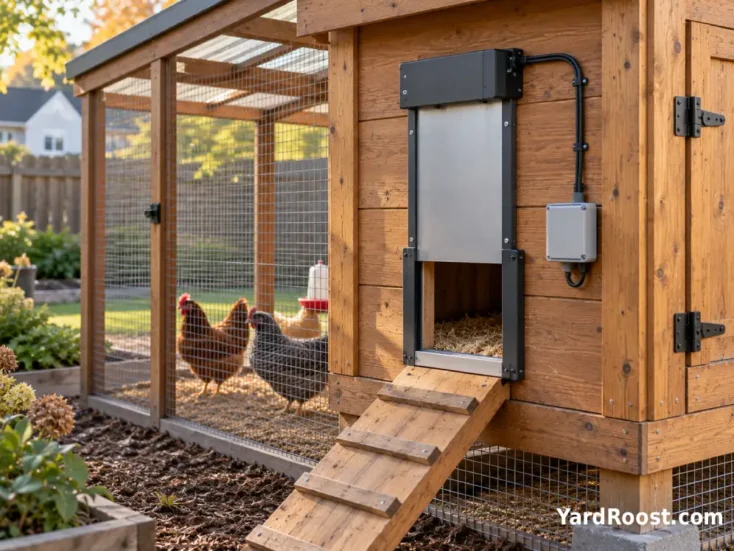
Best Low-Clearance Solar Option: Chickcozy Solar Automatic Chicken Coop Door
The Chickcozy Solar Automatic Chicken Coop Door is worth considering when your coop does not have enough space above the pop hole for a vertical sliding door. Chickcozy lists a solar panel plus built-in rechargeable battery, timer, light, and manual modes, a 6.5-foot cable, overall dimensions of 12 inches wide by 15.5 inches high, and an opening size of 8.25 inches wide by 10.4 inches high.
Best for: Coops with limited overhead clearance and keepers who prefer a center-opening horizontal door.
Why it made the list: Horizontal doors can be useful when rafters, nest boxes, low roofs, or trim block the space a vertical door needs. The solar version also has a separate control box, which may make placement easier when the best sunlight is not directly beside the pop hole.
- Practical upside: Good option for compact coops where a vertical sliding door would hit the roofline or framing.
- Main trade-off: Any door with moving side panels still needs clean edges and a flat mounting surface.
- Solar note: Chickcozy lists a 3200mAh rechargeable battery and solar-powered design, but readers should verify the current model, availability, warranty, and support before buying.
- Skip it if: Your coop face is warped, uneven, or likely to pack the doorway with bedding and mud.
- Check before buying: Opening size, panel cable route, sun exposure, and whether the latest model matches the specs shown on the product page.
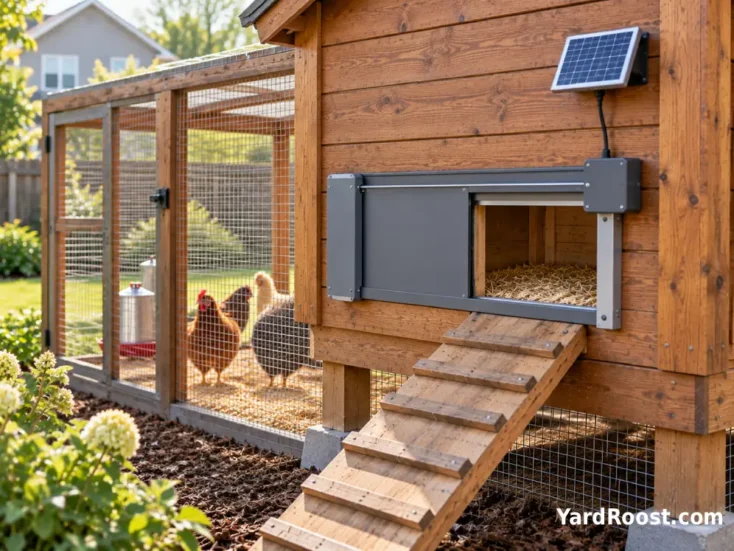
Buying Guide: What Matters Most Before You Buy
Start with fit. Measure the opening your chickens actually walk through, not just the outer frame. Then check the full product dimensions, because some doors need several inches above, beside, or below the opening to move correctly. A door that almost fits is a door that may bind, scrape, or fail when the weather changes.
Next, choose your power source. Battery doors are simple and shade-friendly, but you need a reminder to replace batteries before they fail. Solar powered automatic chicken coop door models reduce battery chores, but only when the panel receives good sun. Plug-in power can be reliable, but outdoor cords, moisture, dust, and bedding all raise safety and routing concerns. Use weather-appropriate equipment and follow the manufacturer manual.
- Choose light sensor if your flock follows natural sunrise and dusk reliably.
- Choose timer control if your coop is shaded, near a porch light, or affected by streetlights.
- Choose app alerts if you travel or want door-status reassurance.
- Choose a larger opening for big hens, fluffy breeds, ducks, or mixed flocks.
- Choose a self-locking or lift-resistant design if raccoons, foxes, dogs, or other predators are a serious concern.
YardRoost editorial note: Do not let the phrase predator-proof do too much work. A strong automatic door helps at one opening. The rest of the coop still needs secure latches, hardware cloth or strong welded mesh where appropriate, tight seams, a protected run, and regular inspections.
Solar Chicken Coop Door Vs Battery Door
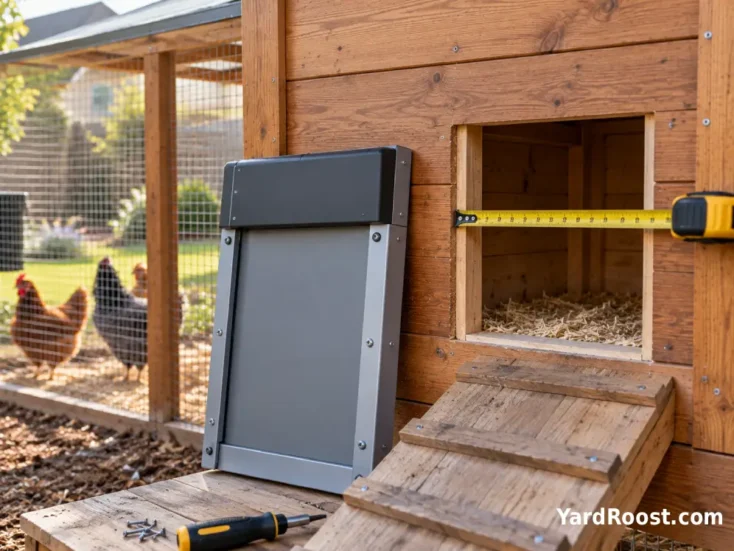
A solar chicken coop door is usually the better choice when your coop is far from the house, gets reliable sun, and you dislike replacing batteries. It can also be useful for mobile coops, garden coops, or remote pasture-style setups where running power would be inconvenient.
A battery-powered automatic door is usually the better choice when your coop is shaded, tucked under trees, or mounted on the north side of a garage, shed, or privacy fence. Batteries are also easier to troubleshoot: if the door acts weak, replace the batteries with the manufacturer-recommended type and check the rails.
| Door Type | Best Situation | Hidden Risk | Best Buyer |
|---|---|---|---|
| Solar powered chicken coop door | Sunny coop face with no outlet nearby | Panel shade, snow cover, weak winter charging | Keeper who wants low battery maintenance |
| Battery automatic door | Shaded coops and simple installations | Forgotten battery changes | Keeper who wants fewer setup variables |
| Plug-in automatic door | Coop close to a safe power source | Unsafe cord routing or moisture exposure | Keeper comfortable following outdoor electrical guidance |
| Hybrid solar or DC kit | Custom coops and larger projects | Wrong accessory or wiring choice | Handy keeper who reads manuals carefully |
Installation And Maintenance Tips
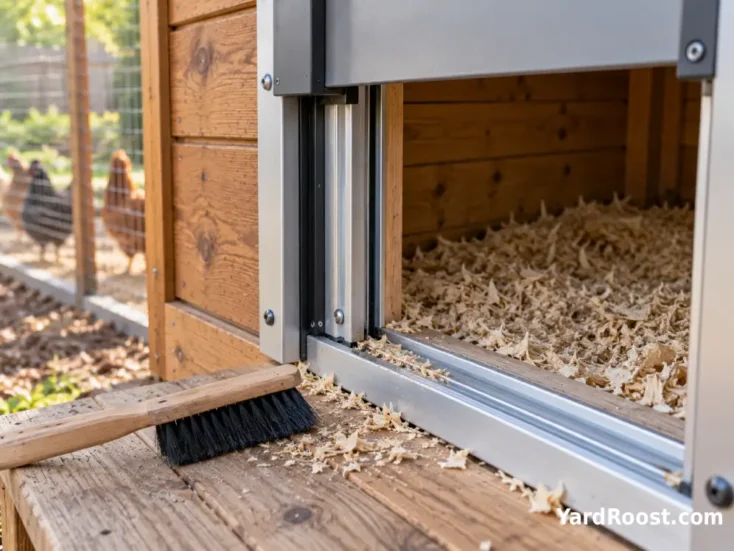
The most common automatic door problems are ordinary coop problems: dirt, bedding, mud, snow, ice, weak batteries, and poor placement. Mount the door on a flat surface, avoid overtightening screws, and test it several times before trusting it overnight.
- Cut the opening cleanly and sand rough edges.
- Keep bedding from piling against the threshold.
- Place light sensors away from porch lights, security lights, and deep shade.
- Check the door manually after heavy rain, wind, snow, or freezing weather.
- Replace batteries before extreme cold rather than waiting for a low-battery warning.
- Keep the manufacturer manual in a coop folder or saved on your phone.
Cleaning matters for household health too. The CDC recommends washing hands after handling backyard poultry, eggs, poultry food, water containers, or equipment, and keeping poultry equipment outside food-preparation areas. That applies when you install, clean, or troubleshoot an automatic chicken coop door.
Mistakes To Avoid
The first mistake is buying by price alone. Cheap automatic chicken coop doors can work, but low-cost models often have vague specs, unclear manuals, limited replacement parts, or exaggerated predator claims. If the listing does not clearly show opening size, power source, manual override, weather rating, and support, keep looking.
- Do not buy a door before measuring your pop-hole and full mounting area.
- Do not assume solar will work in shade or under snow.
- Do not trust an automatic door as your only predator protection.
- Do not mount the door where bedding, mud, or manure can pack into the track.
- Do not use indoor-only cords or adapters outdoors.
- Do not ignore your flock’s bedtime during the first week. Watch whether everyone gets inside before the close time.
- Do not use manufacturer bird-capacity claims as proof that the doorway is comfortable for your largest birds.
Safety Notes For Predators, Weather, And Flock Routine
An automatic door is one layer of security. It helps most when the rest of the coop is already solid: locked access doors, tight corners, secured vents, predator-resistant mesh, and a clean area around the coop that does not invite rodents or nighttime visitors.
Colorado State University Extension recommends reducing predator pressure by keeping coop areas clean, removing debris and food sources, training birds to return to the chicken house, and keeping the henhouse locked at night. That is the right way to think about a chicken coop automatic door: helpful routine support, not a magic shield.
For winter, check the door after freeze-thaw weather. For summer, make sure the closed door does not reduce needed ventilation; vents should be protected separately with suitable mesh. For any electrical or solar setup, follow the product manual, use outdoor-rated components where required, and avoid routing cords where chickens can peck them or bedding can pile against them.
FAQ
Are Automatic Chicken Coop Doors Worth It?
Yes, for many backyard flocks. They are most worth it when you are often away at dusk, have unpredictable mornings, or want a more consistent coop routine. They are less useful if your coop is poorly secured, your flock does not reliably go in at night, or you will not maintain the door.
Is A Solar Powered Chicken Coop Door Better Than Battery?
Solar is better for sunny, outlet-free coops. Battery is better for shaded coops and simpler troubleshooting. The best solar powered chicken coop door for one yard may be a poor fit in another yard if the panel is shaded by trees, a fence, or the coop roof.
Will An Automatic Coop Door Keep Raccoons Out?
It can help close one vulnerable opening, especially if the design locks or resists lifting. It should not be treated as a complete raccoon solution. Use secure latches, strong mesh, tight framing, and regular inspections around the whole coop and run.
What Is The Best Automatic Chicken Coop Door For Cold Weather?
Based on listed specs, ADOR1 is a strong cold-weather candidate because the manufacturer lists operation down to -20°F. Omlet and ChickenGuard also list below-freezing operating ranges, but any door can struggle if ice, snow, swollen wood, or weak batteries interfere with movement.
Should I Use Timer Mode Or Light Sensor Mode?
Use light sensor mode if your coop has natural light and no confusing porch lights or streetlights nearby. Use timer mode if the coop is shaded, the light sensor closes too early, or you want a fixed safety routine. Some keepers use light sensor mode with a delayed close setting when the product allows it.
How Long Does It Take Chickens To Learn An Automatic Door?
Many adult hens adjust within a few days, but you should observe the first week. Start with a close time that gives stragglers extra time, then tighten the schedule once you know your flock’s routine. Young birds, new birds, or birds moved to a new coop may need more supervision.
Final Verdict: Which Automatic Chicken Coop Door Should You Buy?
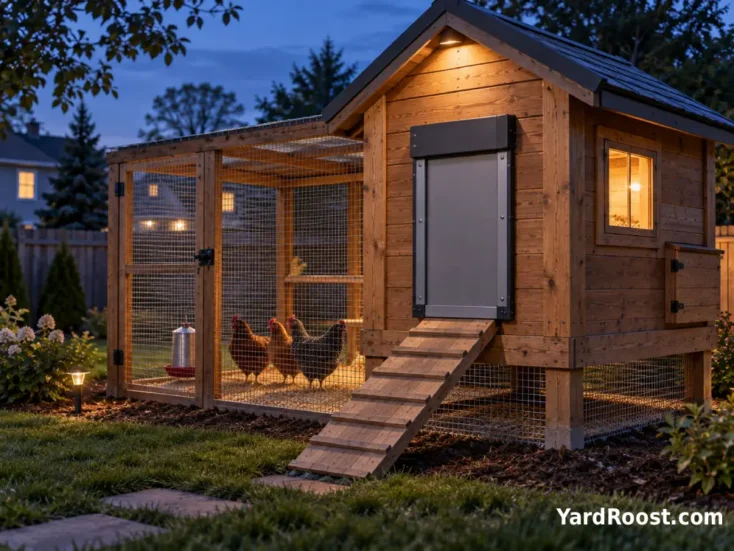
Choose the Omlet Smart Automatic Chicken Coop Door if you want the most balanced automatic door for a typical backyard wooden coop. Choose the Run-Chicken Eternal if your priority is a solar powered automatic chicken coop door and your coop gets dependable sunlight. Choose the Run-Chicken T50 if you want a compact battery-powered door with a clean all-in-one design.
Choose ADOR1 if you want a heavier-duty, no-app door with a larger opening and strong cold-weather specs. Choose ChickenGuard if you want a more flexible opener-and-door kit with multiple power options. Consider Chickcozy Solar if you need a horizontal, low-clearance automatic solar chicken coop door and you can verify the current model details before buying.
The safest buying path is simple: measure first, choose power second, check controls third, and treat predator resistance as a whole-coop project. The right automatic door should make your routine calmer while still keeping you involved enough to notice when your flock, coop, or weather conditions change.