One minute your hens are scratching under the feeder; the next, they are racing toward the coop after a shadow passes overhead. Seeing a hawk near your chickens is unsettling, especially if you have already lost a bird. The good news is that you can reduce the risk without harming the hawk or keeping your flock locked in a dark building all day.
The most dependable way to keep hawks away from chickens is to block their access: use a securely covered outdoor run, add places for hens to hide when they roam, and supervise any time spent outside that protected space. Shiny objects, fake owls, and noise may briefly startle a raptor, but they cannot replace a physical barrier.
Start by protecting the place your flock uses every day. Then decide whether free-ranging can fit safely into your routine. A small, thoughtfully arranged backyard often gives hens more usable protection than a large, exposed lawn.
Do Hawks Eat Chickens?
Yes. Hawks can attack and eat chickens, including backyard hens, bantams, and younger birds. The nickname chicken hawk is not one precise species. In North America, red-tailed, red-shouldered, and Cooper’s hawks are among the raptors identified in small-flock predator guidance. The species, size of the chicken, nearby habitat, and opportunity all affect the risk.
Hawks usually pose a daytime threat, while owls are more often a concern around dusk or overnight. That distinction matters: shutting the coop after dark is essential for many predators, but it does little for a hen feeding in an uncovered run at lunchtime.
Nor should a hovering hawk automatically be blamed for every missing bird. Dogs, foxes, coyotes, and other predators can leave similar evidence. University of New Hampshire Extension and Virginia Cooperative Extension both recommend considering the timing, access point, and condition of the scene rather than treating one feather pile as proof.
Chickens that abruptly freeze, sound alarm calls, or rush under cover may be responding to an aerial threat. Take the reaction seriously, even if you never spot a hawk yourself.
What Works Best Against Hawks?
A protected run comes first because it changes what a hawk can physically reach. University of Maryland Extension, Colorado State University Extension, and the small-flock Poultry Extension program all recommend mesh or netting over outdoor poultry runs to reduce attacks by flying predators.
| Protection Method | What It Does | Practical Limit |
|---|---|---|
| Secure overhead roof or mesh | Blocks direct access to hens in the run | Only works if seams, doors, and edges stay closed |
| Taut, purpose-made hawk netting | Creates an overhead barrier for a supported enclosure | Must be inspected for sagging, tears, snow, and entanglement risk |
| Low shrubs and sturdy hideouts | Give roaming hens somewhere to move out of sight | Do not make an open yard predator-proof |
| Supervised free-range time | Lets you respond when birds alarm or a hawk appears | A person nearby cannot prevent every rapid attack |
| Reflective tape, decoys, and sound | May temporarily discourage an approaching bird | Hawks may become accustomed to them |
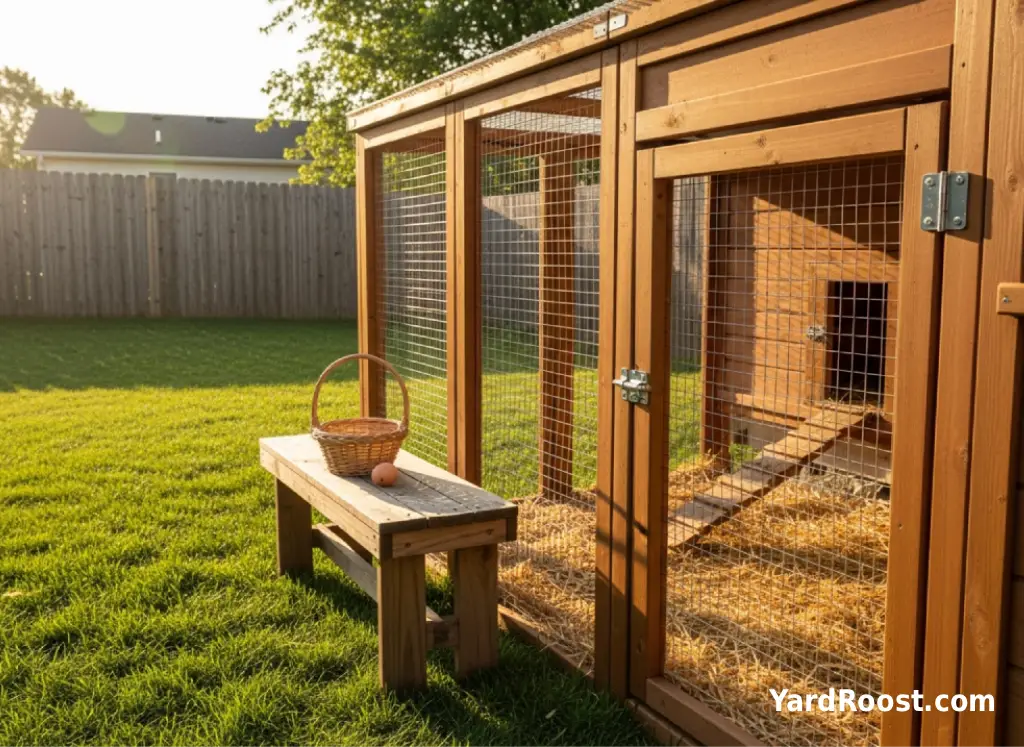
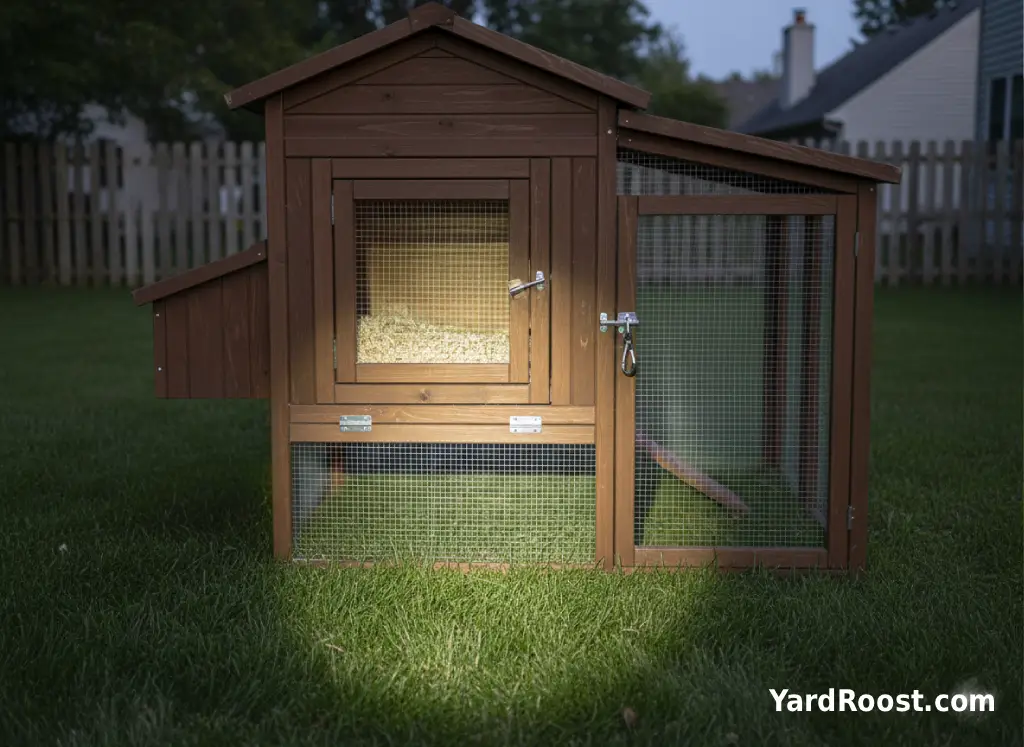
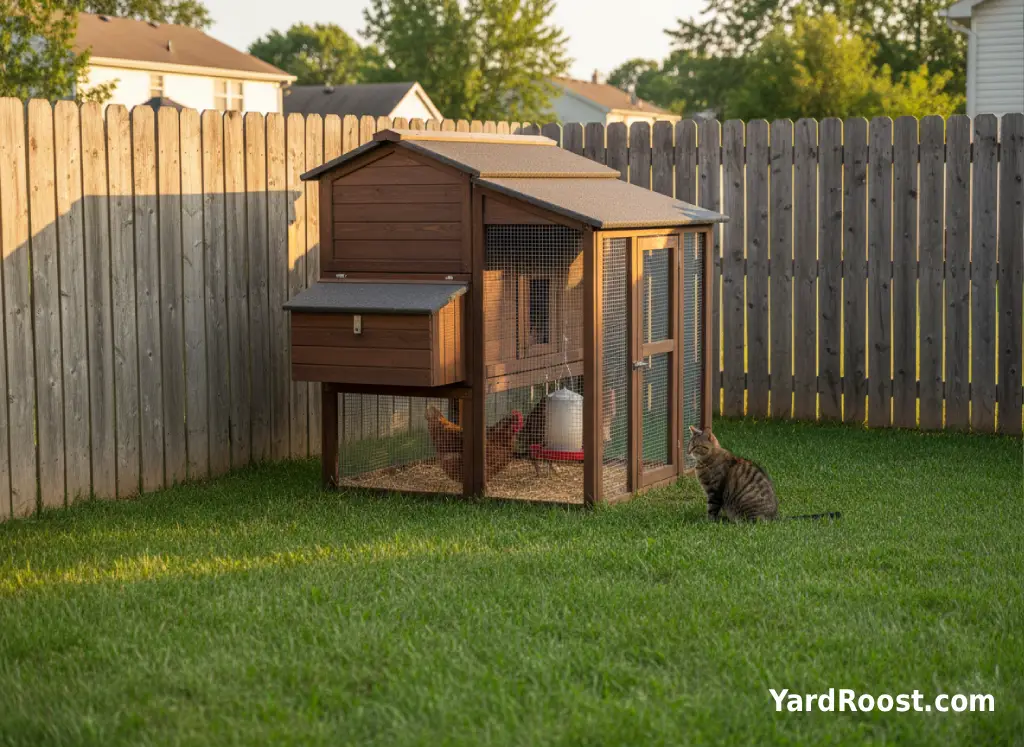
For a small flock, the strongest arrangement is a spacious covered run for routine daytime use, with any open-yard time treated as optional and higher risk. A well-planned chicken run also makes it easier to provide shade, drainage, and a secure gate in one place.
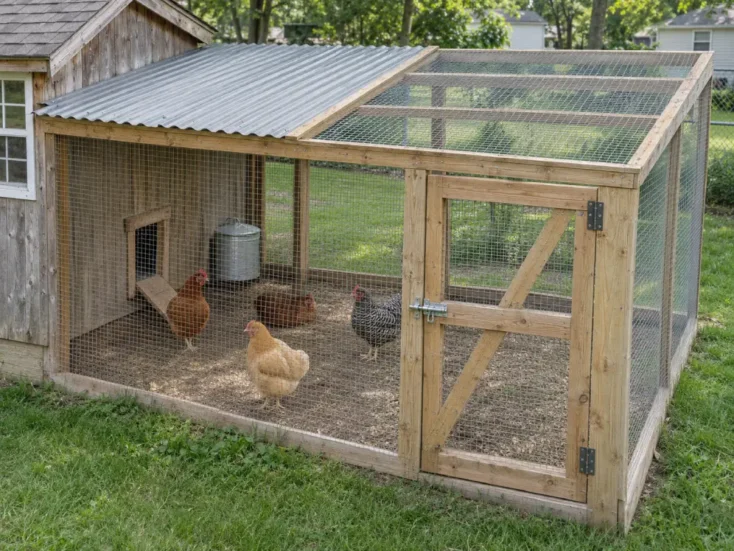
How to Hawk-Proof a Chicken Run, Step by Step
Before buying netting, look up from inside the run. Follow the roofline with your eyes: are there open corners, an uncovered doorway, or a narrow gap where the run meets the coop? A hawk does not need the entire roof to be missing if there is one usable opening.
1. Measure the Entire Open Area
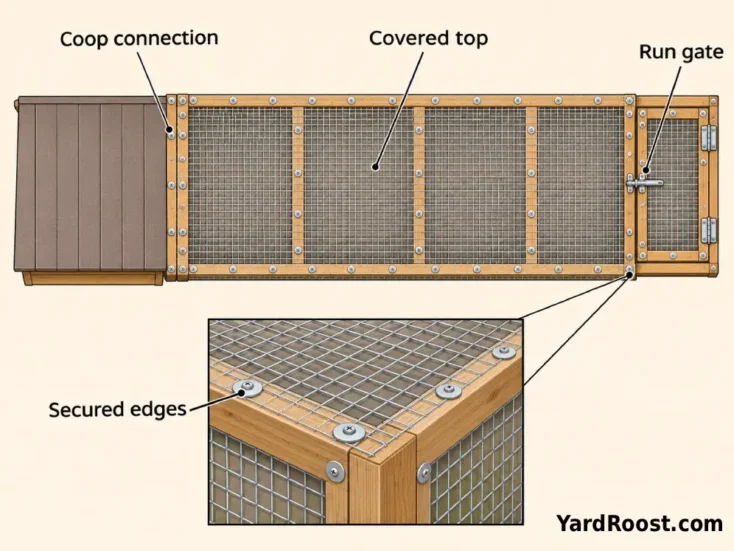
Record the run’s length and width, including any irregular corners. Include the gate approach and the connection to the coop in your sketch. The aim is continuous overhead protection, not a patch of cover in the middle with exposed edges around it.
2. Match the Cover to Your Weather and Other Predators
A framed roof with suitable solid panels or securely fastened welded wire can be a durable choice for a permanent run. Purpose-made, UV-resistant aviary or hawk netting can suit some supported runs, but it must be strong enough for the installation and kept taut. Follow the manufacturer’s guidance for anchoring, span, wind, and weather loading. In areas with substantial snow or ice, use a roof engineered for those loads rather than relying on flat lightweight netting.
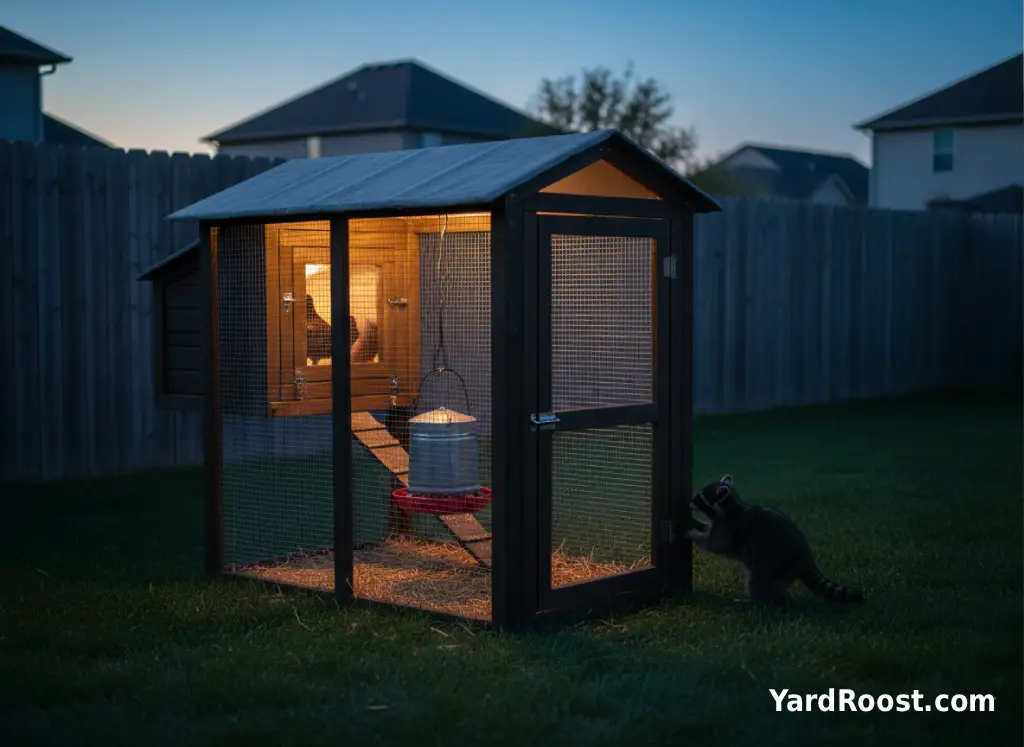
Remember that a hawk barrier is not automatically a raccoon barrier. Flexible netting may discourage attacks from above but can leave the run vulnerable to climbing mammals. For lower walls, doors, vents, and other reachable openings, use secure predator-resistant wire rather than thin chicken wire alone. YardRoost’s coop-building guide explains why framed doors, tight seams, and sound hardware matter as much as the roof.
3. Install Supports and Fasten Every Edge
Use a frame or support system that keeps the covering above the birds and prevents deep sagging. Attach the material securely along the perimeter and at structural supports using hardware appropriate to its material and manufacturer instructions. Avoid exposed sharp wire ends, loose loops, and dangling cords where chickens or wild birds could become trapped.
4. Close the Awkward Gaps
Check around roof corners, gates, pop doors, trees passing through the enclosure, and places where two materials overlap. If you can pull an edge back easily by hand, reinforce it. Check the installation from inside the run as well as from outside: the underside often reveals hanging or damaged sections you would miss from the ground.
5. Test the Daily Routine Before Allowing Unsupervised Access
Close and latch every door, walk the perimeter, and observe how the hens move through the run. Watch for birds getting too close to the overhead material when they fly up in alarm. A frightened chicken needs room to move without catching a wing or head in mesh.
6. Inspect After Storms and During Routine Chores
Look for loose fasteners, frayed netting, fallen branches, stretched corners, and snow or leaf buildup. Fix damage before birds use the area again. A cover that was secure last spring may not be secure after a windy night.
How to Protect Free-Range Chickens From Hawks
A yard can look full of shelter to a person yet still feel exposed to a chicken. Tall trees may shade the lawn, but they do not necessarily provide a quick hiding place near ground level. The important question is whether a hen in the middle of the yard can reach a sturdy refuge without crossing a long stretch of open grass.
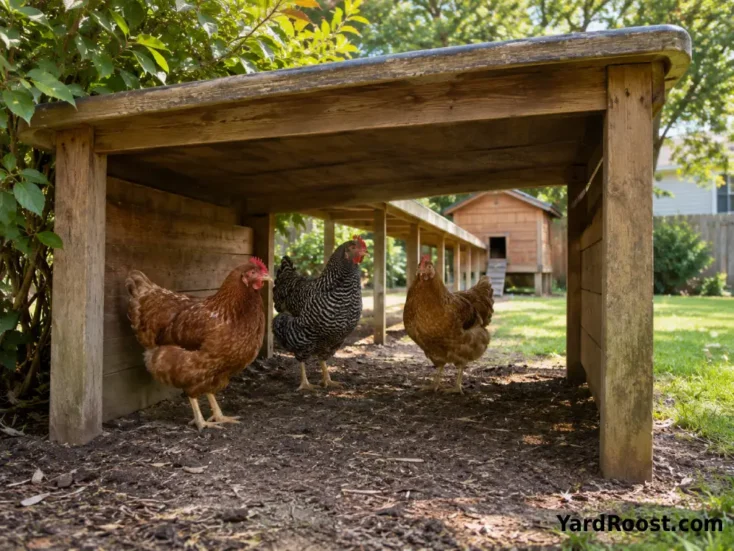
Set up several low hiding places near common foraging areas. Dense, chicken-safe shrubs can help; so can a well-secured shade table, a small roofed shelter with more than one exit, or a sturdy low platform that birds can duck beneath. Keep hideouts stable, free of exposed nails and sharp edges, and open enough that a dominant hen cannot trap a timid flockmate inside.
A covered path between the coop and a favorite scratching patch may be a better investment than another bird scarer. If a hen must dash across the whole lawn to reach the coop, her apparent freedom comes with a long exposure window. Treat open free-ranging as a privilege of calm, well-supervised periods—not a substitute for a safe daytime run.
Observe the flock for a few minutes at ground level. The birds often reveal the problem themselves: they bunch against a fence, hesitate in a bare corner, or repeatedly use one shaded bush. Those are good places to add cover or change the route back to safety.
Do Hawk Deterrents for Chickens Really Work?
Most gadgets sold to scare hawks are better understood as temporary distractions than dependable protection. A reflective strip or moving scarecrow might change a bird’s approach for a time. It may also do very little, especially if a hawk has repeatedly found an easy hunting opportunity in the same open yard.
- Reflective tape and hanging objects: Use only where they cannot tangle with birds or fall into the run; move or remove them if the effect fades.
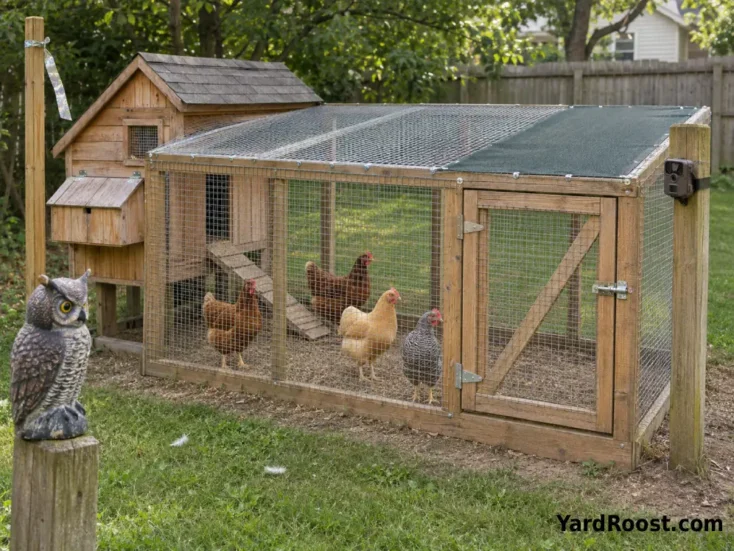
- Plastic owls and hawk decoys: Do not rely on stationary models as a safety barrier. Familiar objects can become part of the scenery.
- Noise or motion devices: Be mindful of stressed chickens, neighbors, pets, and local restrictions. They are not a replacement for a covered run.
- Roosters: Some alert a flock to overhead danger, but a rooster cannot reliably stop an attack and may not be allowed under local ordinances.
- Dogs: A genuinely poultry-safe, trained dog may discourage some wildlife, but an untrained dog can injure chickens and introduce a different hazard.
YardRoost editorial note: The expensive mistake is buying three deterrents while leaving the run roof open. We would spend the first dollars on continuous cover and secure fastening, then consider low-risk extras only if they fit the yard.
Likewise, strings or wires stretched across an open yard may complicate a raptor’s approach, but they are not equivalent to a fully covered enclosure. Poorly visible line can become an entanglement hazard. Avoid loose fishing line, adhesive traps, and any device intended to catch or injure wildlife.
How to Tell Whether a Hawk Attacked Your Flock
Hawks often hunt in daylight, and you may see a sudden dive, a panicked flock, feathers scattered in the grass, or a bird that has been eaten at the attack site. But no single clue identifies the predator with certainty. Larger hawks can leave a different scene from smaller raptors, and ground predators may attack during daylight too.
After bringing the surviving birds to safety, note the approximate time, which birds are missing, whether the run roof or walls were open, and any tracks, feathers, or disturbed fencing. A motion-activated wildlife camera aimed toward the run can help identify repeat visitors without guessing. Keep the camera positioned so it does not interfere with daily access.
YardRoost’s guide to identifying chicken predator clues helps distinguish aerial attacks from common signs left by foxes, dogs, raccoons, and other animals. Fix the access point you can confirm instead of assuming every loss is the work of a hawk.
What to Do Immediately After a Hawk Attack
The minutes after an attack are for securing survivors and checking injuries, not chasing the hawk. Never try to grab or corner a raptor. If the bird remains nearby or behaves unusually, keep people and pets back and contact local wildlife authorities for guidance.
- Move the flock into a secure, covered space. Count your birds and close gates before searching farther afield.
- Check each chicken calmly. Look for blood, punctures, drooping wings, limping, unusual weakness, or abnormal breathing. Feathers can hide wounds.
- Keep an injured bird quiet and protected. Separate it safely from flock pecking and contact a poultry or avian veterinarian for specific guidance.
- Document the scene. Photos of damaged fencing, feathers, and the general location may help identify the predator and guide repairs.
- Stop open-yard access until the weakness is corrected. A brief period using the secure run is preferable to another preventable exposure.
Handle bloodied materials or dead birds with appropriate protection, keep children and pets away during cleanup, and wash hands after handling poultry or their environment. Follow local rules for carcass disposal. Avoid assuming a bird is unharmed just because it stands up and walks away.
Common Mistakes to Avoid
Hawk protection fails most often at the places that look almost finished. An enclosure may have tight sidewalls yet leave a gap over the gate. A tidy net roof may become a sagging web after storms. Or a favorite foraging area may offer excellent shade but nowhere low enough to hide.
- Covering only part of an otherwise open run: Make the entire roofline secure; use a solid roof for shade where useful, with strong coverage over the rest.
- Confusing chicken wire with all-predator protection: Overhead wire can deter raptors when properly installed, but flimsy fencing may fail against mammals that pull, chew, or climb.
- Letting hens roam because someone is home: A person indoors, even watching through a window, cannot always intervene before a quick attack.
- Relying on one shrub: Spread sturdy hiding places around active foraging areas rather than forcing every bird toward the same distant refuge.
- Ignoring escapes and roof defects: Hens may flap over an uncovered edge when startled. As our guide to how chickens fly and clear fences explains, even brief bursts of flight matter to enclosure design.
Once each week, use the same route to check the cover, supports, gate, coop seam, ground edge, and hiding spots. Repeat the check after high winds, heavy rain, snow, or any alarm incident. Consistency catches small failures before they become serious ones.
Can You Legally Harm a Hawk to Protect Chickens?
Do not shoot, trap, poison, injure, or attempt to relocate a hawk yourself. Native hawks are generally protected under the federal Migratory Bird Treaty Act, and state requirements may also apply. The U.S. Fish and Wildlife Service explains that taking protected migratory birds generally requires federal authorization. Permitting and any exceptions are specific legal matters, not something to assume from an online tip.
Choose nonlethal exclusion first: secure overhead cover, better run design, and carefully supervised ranging. If a persistent predator problem continues, ask your state wildlife agency or the U.S. Fish and Wildlife Service about lawful options. A hawk doing what wild hawks do is not a reason to put people, pets, or other wildlife at risk.
When to Call an Avian Vet or Get Professional Help
A hawk strike may leave punctures or internal injuries that are difficult to assess from feathers alone. Contact an avian or poultry veterinarian promptly if a bird has bleeding, an open wound, a drooping wing, difficulty standing, trouble breathing, marked weakness, or unusual behavior after an encounter. This guide cannot diagnose an injury or replace examination and treatment by a qualified professional.
If the problem is structural, such as a large run roof that repeatedly fails under wind or snow, consult a qualified local builder or installer familiar with outdoor enclosures. Your local cooperative extension office can also help you review practical predator prevention for your area.
Frequently Asked Questions About Hawks and Chickens
Will a Hawk Come Back After Taking a Chicken?
It may return to a location where it has found food or an accessible flock. Do not plan around a particular number of days or assume it has moved on. Keep hens in a secure covered run until the exposure is fixed, and continue regular checks after that.
Can a Hawk Carry Off a Full-Grown Chicken?
That depends on the hawk and the chicken. Some attacks result in prey being moved; in others, a larger bird may be attacked or eaten on the ground. An adult hen is not automatically safe because she seems too heavy to carry.
Is Ordinary Garden Bird Netting Enough?
Not necessarily. Lightweight garden netting can tear, sag, or entangle animals. Choose a purpose-made cover appropriate for the run’s span and local conditions, install it securely, and inspect it frequently. For a permanent all-predator enclosure, a framed, adequately strong roof is usually a better long-term investment.
Should Chickens Stay Inside After You See a Hawk?
Keep them in a secure roofed run or coop while you assess the risk. A properly covered outdoor run still allows daytime activity without exposing the flock to an open sky. You do not need to permanently confine chickens to a dark coop simply because hawks live nearby.
The Best Long-Term Plan Is a Safer Daily Space
Protecting chickens from hawks is less about winning a contest with a clever bird and more about removing easy access to your flock. Start with a continuous overhead barrier on the run. Check its edges, seams, and supports. Then make the rest of your backyard friendlier to cautious hens by adding low cover near the places they already scratch and rest.
Use a simple decision rule: when you cannot confidently protect the open yard, give the flock its daylight in the covered run instead. If you do offer supervised free-range time, keep an eye on alarm behavior and return birds to safety promptly when a raptor appears.
For your next coop check, stand inside the run, look straight up, and follow every edge of the roof. The most useful first fix is usually the weak opening you can see—not another gadget hanging from a tree.
Sources informing this guidance include University of Maryland Extension, Colorado State University Extension, Virginia Cooperative Extension, the Small and Backyard Poultry Extension program, University of New Hampshire Extension, and the U.S. Fish and Wildlife Service.