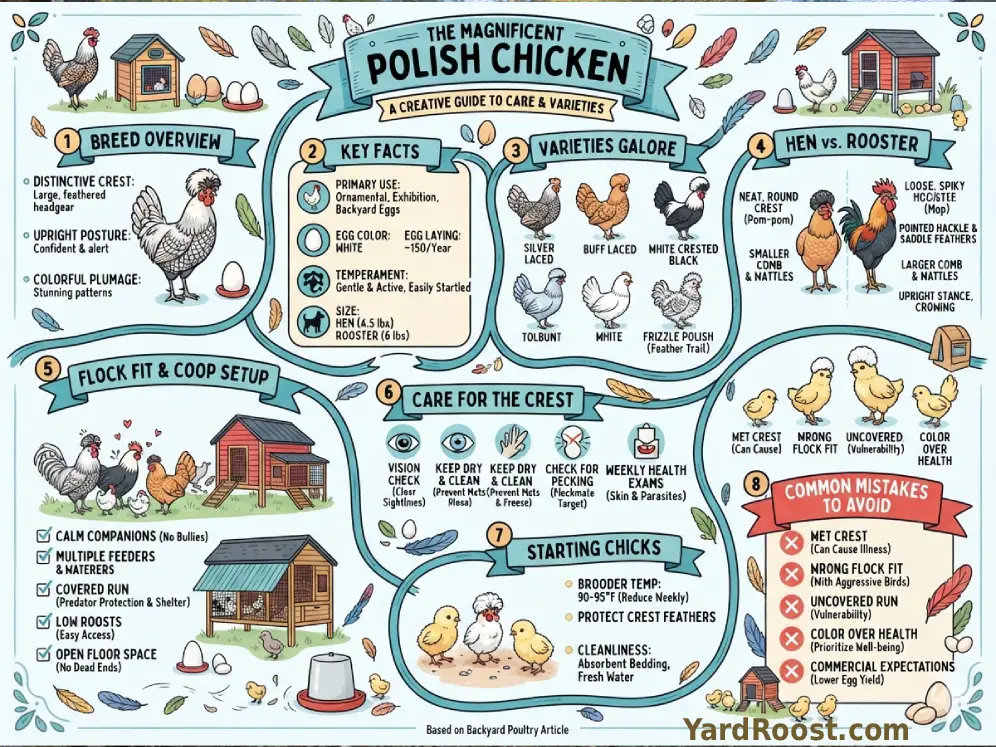
The Polish chicken is easy to recognize. Its large feathered crest, upright posture, and colorful plumage give it an appearance unlike almost any other backyard breed. Underneath that dramatic headgear is a generally gentle, active chicken that can be a rewarding addition to the right flock.
Polish chickens are often kept as ornamental or exhibition birds, but Polish hens also lay useful white eggs. Their most important care consideration is the crest itself. Feathers can limit vision, collect moisture, attract pecking from flockmates, and make a bird easier to surprise. A secure run, dry housing, and calm companions matter more for this breed than decorative coop extras.
This guide covers common colors such as silver laced Polish, buff laced Polish, White Crested Black, White Crested Blue, and Tolbunt. It also explains Polish hen versus rooster differences, egg production, chick care, frizzle genetics, and the practical details beginners should consider before bringing these crested birds home.
What Makes the Polish Chicken Different?
Despite the name, the breed’s exact origin is uncertain. Crested chickens resembling today’s Polish appear in European paintings from the 1400s onward. Dutch poultry keepers are generally credited with refining the breed’s elaborate crest and color patterns, and Polish chickens reached the United States during the 1800s. They have also been called Poland, Paduan, and Tophat chickens.
The crest grows over a rounded bony prominence on the skull. Some birds also have a beard and muffs, while others have a clean face beneath the crest. A small V-shaped comb may be partly or completely hidden by feathers.
| Breed Feature | Typical Polish Chicken |
|---|---|
| Primary Use | Ornamental, exhibition, and backyard eggs |
| Egg Color | White |
| Egg Size | Usually medium to large |
| Standard Adult Weight | About 4.5 pounds for hens and 6 pounds for roosters |
| Temperament | Usually calm but easily startled |
| Broodiness | Generally uncommon |
Polish chickens are lighter and more agile than many heavy backyard breeds. Some can fly onto fences, shed roofs, or tree branches when frightened. That ability, combined with limited vision, makes a covered and securely enclosed run a sensible choice.
Polish Chicken Colors and Varieties
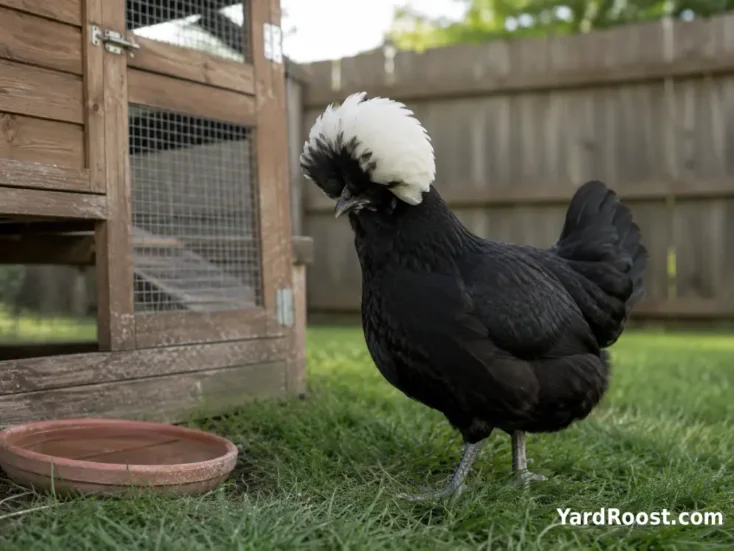
Color does not turn a Polish chicken into a different breed. Terms such as silver laced Polish chicken, buff laced Polish hen, or White Crested Black Polish rooster describe plumage varieties within the broader breed.
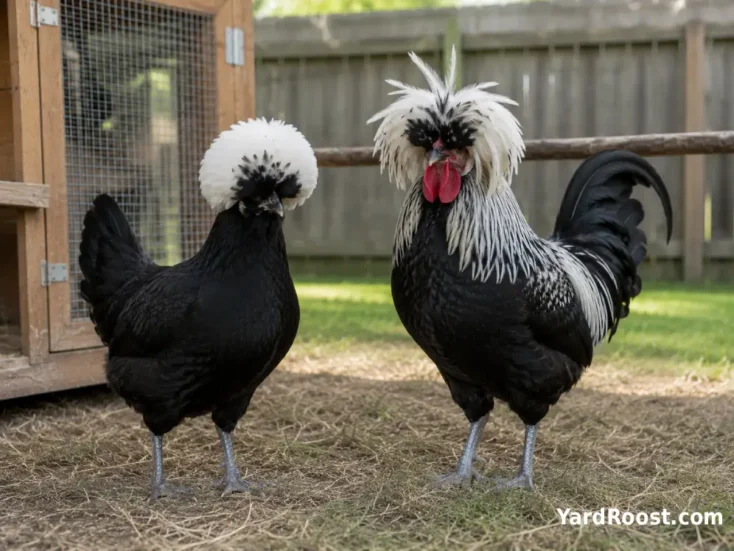
- White Crested Black Polish have predominantly black bodies topped by contrasting white crests.
- White Crested Blue Polish have blue-gray body feathers and white crests, although the shade and markings can vary.
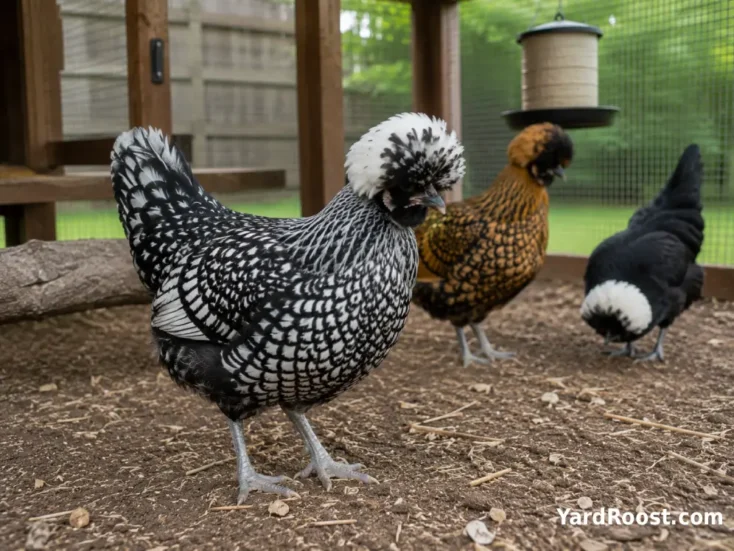
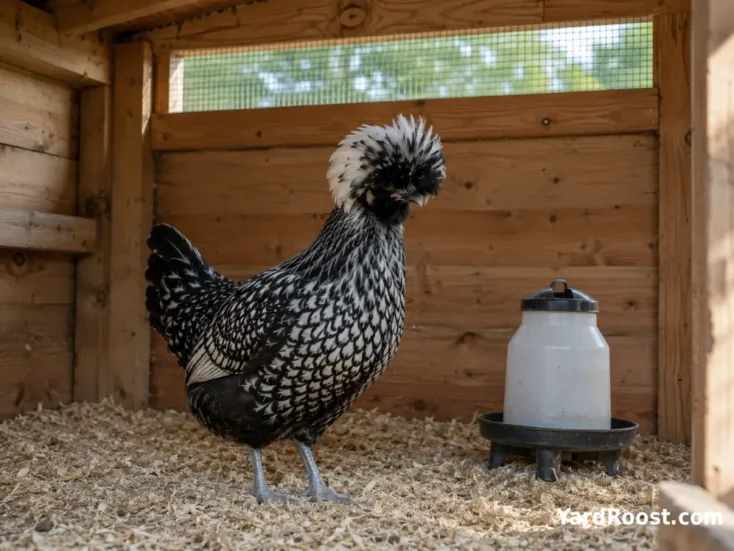
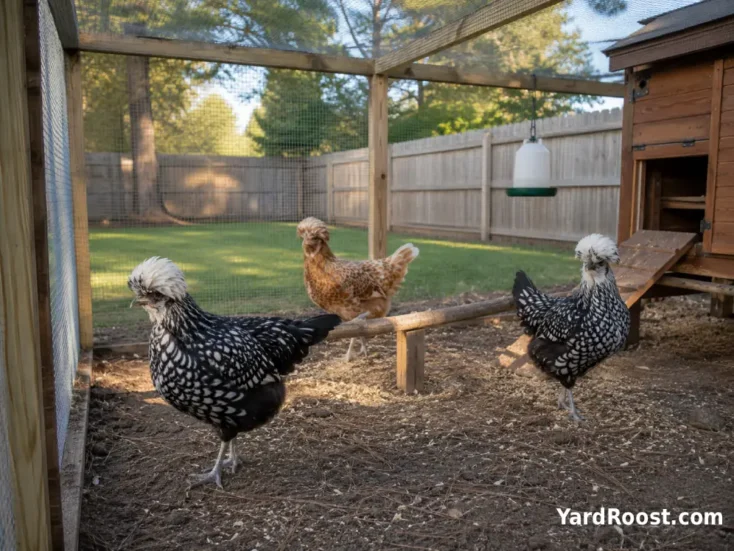
- Silver laced Polish chickens have pale silver or white feathers outlined with dark lacing.
- Golden laced Polish have warm golden feathers edged in black.
- Buff laced Polish chickens combine soft buff coloring with lighter contrasting edges.
- White Polish have mostly white plumage, with bearded and non-bearded lines available.
- Tolbunt Polish chickens display a mottled combination of brown, black, and white rather than a uniform laced pattern.
The American Poultry Association has recognized a number of bearded and non-bearded Polish varieties over the breed’s history, including Golden, Silver, White, Buff Laced, White Crested Black, and White Crested Blue. Exhibition standards can be revised, so anyone buying show prospects should consult the current Standard of Perfection rather than relying only on a hatchery label.
Tolbunt Polish are popular with specialty breeders, but Tolbunt coloring should be treated as a developing color project rather than proof that a bird meets a particular exhibition standard. The same caution applies to uncommon names such as Black Crested White. Ask the breeder what traits are being selected, whether the birds are large fowl or bantams, and whether the line is bred for exhibition, backyard companionship, or color alone.
Polish bantam chickens offer the same crested appearance in a smaller body. Their reduced size can work well in limited spaces, but bantams still need secure housing and protection from larger flockmates and predators.
Temperament and Flock Fit
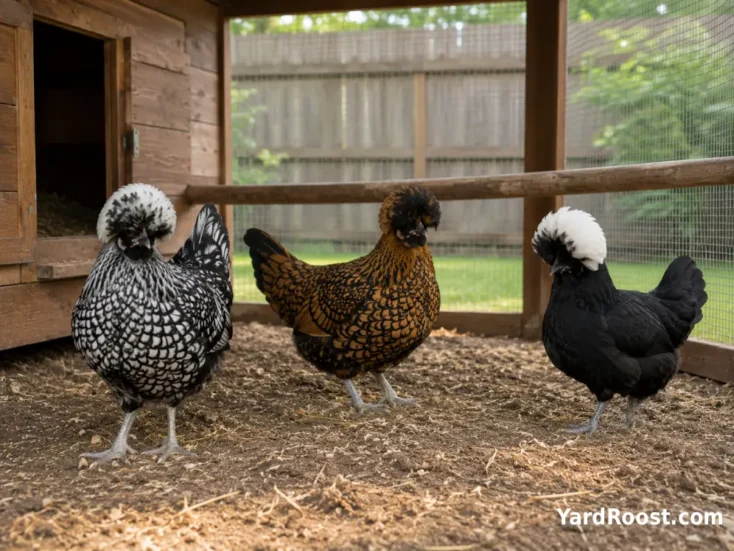
Most Polish chickens are gentle and manageable, but they can appear nervous when they cannot see something approaching. A hand reaching over the crest or a dog suddenly appearing beside the run may cause a bird to jump, run, or fly even when it is normally friendly.
Talk before touching or lifting a crested Polish hen. Approach from the front or side where she has the best chance of seeing you. Consistent, quiet handling from chickhood can help, but the goal should be calm predictability rather than forcing a frightened bird to tolerate attention.
The crest can also make social signals harder to read. A Polish chicken may not notice a dominant hen approaching, and assertive flockmates sometimes peck at crest feathers. Oklahoma State University notes that the breed can be bullied by more aggressive chickens and may need additional room to avoid crest picking.
A good mixed flock setup includes:
- Calm companions that do not routinely chase or corner crested birds
- More than one feeder and water station when competition is noticeable
- Open floor space without dead-end corners
- Low and moderate roosting options that are easy to locate
- An overhead cover or fully enclosed run for predator protection
A Polish rooster may be calm, protective, nervous, or occasionally confrontational, just like a rooster of any other breed. Evaluate the individual bird rather than assuming the crest guarantees a particular personality. Before keeping any rooster, check local ordinances, zoning rules, and HOA restrictions related to poultry and noise.
Polish Hen vs. Polish Rooster
Sexing Polish chicks by appearance can be frustrating. Crest shape is useful in mature birds, but it is not a dependable stand-alone method for very young chicks. Individual lines feather differently, and an uneven juvenile crest can change considerably as the bird grows.
A mature Polish hen usually has a more rounded, tidy crest that resembles a pom-pom. A Polish rooster generally develops a looser crest with longer, pointed streamers. The Livestock Conservancy describes the hen’s crest as neat and rounded while the rooster’s looks more like an untidy mop.
Look at several characteristics together:
- Roosters often develop longer, more pointed hackle and saddle feathers.
- A male’s V-shaped comb and wattles may become larger, although the crest can hide them.
- Roosters usually develop longer, curved tail feathers and a more upright stance.
- Crowing is strong evidence of a male, though the age at which it begins varies.
- Egg laying confirms a hen, but waiting for an egg is obviously a late answer.
Behavior alone is not reliable. A confident pullet can stand tall and challenge flockmates, while a quiet young cockerel may remain inconspicuous for weeks. For buyers who cannot keep roosters, purchasing older sexed pullets from a reputable source is safer than gambling on unsexed Polish chicks.
Polish Chicken Eggs, Hatching, and Chick Care
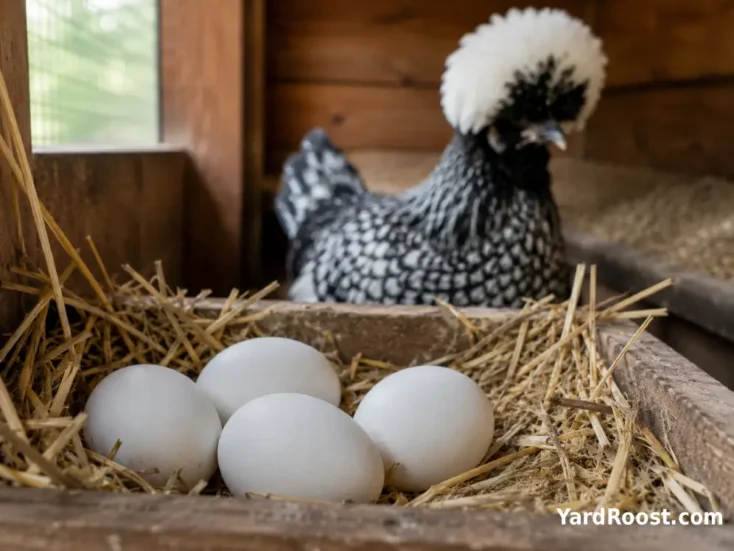
Polish chicken eggs are white and commonly medium to large. The Livestock Conservancy gives roughly 150 eggs per year as a practical breed benchmark, although actual production varies with genetics, age, nutrition, daylight, molting, weather, stress, and health. Polish hens can be persistent layers, but they are not a direct substitute for commercial egg-production hybrids.
Plumage color does not determine egg color. A silver laced Polish hen, Tolbunt Polish hen, buff laced Polish hen, and White Crested Black Polish hen should all produce white-shelled eggs. Egg size and laying rate may vary between individual lines, but a rare color does not automatically mean a different egg color.
Polish hens are not usually dependable broodies. Anyone purchasing Polish chicken hatching eggs should have a prepared incubator or a proven broody hen available rather than assuming the biological mother will sit. Shipped hatching eggs also have uncertain hatch rates, even when fertile, because handling, age, incubation conditions, and breeder management all influence results.
Starting Polish Chicks
Polish chicks need the same basic brooding setup as other standard chicks: a complete chick starter feed, clean water, absorbent bedding, good airflow without a direct draft, and a warm area they can enter or leave.
University of Minnesota Extension recommends beginning around 90–95°F at chick level and reducing the target by about 5°F each week until supplemental heat is no longer needed. Chick behavior is the better daily check: tightly huddled, loudly calling chicks may be cold, while chicks avoiding the heated area may be too warm.
Because crest feathers become an attractive pecking target, check the brooder several times daily during the first weeks. Red skin, bleeding, or repeated targeting requires immediate separation of the injured chick and correction of possible triggers such as crowding, excessive heat, harsh lighting, or inadequate access to feed.
Our guide to raising baby chicks covers brooder preparation, bedding, feeders, waterers, and heat-source safety in more detail.
Crest Care, Coop Setup, and Seasonal Comfort
A Polish crest is not just decoration. It can reduce peripheral vision, become soaked in rain or drinking water, freeze in cold conditions, conceal irritated skin, and make it harder to spot external parasites. The Livestock Conservancy and Oklahoma State University both emphasize dry housing and the problems caused by wet or restricted crests.
Part the feathers gently at least once a week and examine the skin, feather bases, eyes, and hidden comb. Increase those checks during muddy weather, freezing conditions, or any period when flockmates are pecking at the crest.
The crest should be:
- Dry rather than clumped or waterlogged
- Free from blood, crusts, heavy debris, and unpleasant odor
- Clear enough around the eyes for the bird to locate feed, water, doors, and flockmates
- Free from large numbers of moving insects or attached eggs
Choose a waterer that the bird can use without repeatedly immersing its crest. Position it on a stable, level base and watch the flock drink before deciding the height is correct. A waterer that stays clean but is difficult to reach is not an improvement.
The coop needs ventilation even in winter. High openings help moisture escape without directing a cold draft across birds on the roost. Damp bedding, condensation, or a sharp ammonia odor means airflow and litter management need attention. See our coop ventilation basics for a practical setup checklist.
During rain, prevent crested birds from being trapped outside without shelter. In freezing weather, check for icy feathers before the flock settles for the night. During summer heat, provide deep shade, unrestricted cool water, and airflow at bird level. Polish chickens may tolerate warm weather reasonably well, but panting, wings held away from the body, weakness, or poor coordination require prompt cooling measures and professional guidance if the bird does not recover quickly.
Editorial note: A common mistake we see is worrying about cold air while ignoring damp air. For Polish chickens, a dry, ventilated coop is usually safer than a sealed coop that traps moisture around the crest and bedding.
Frizzle Polish Chickens and Tolbunt Color Projects
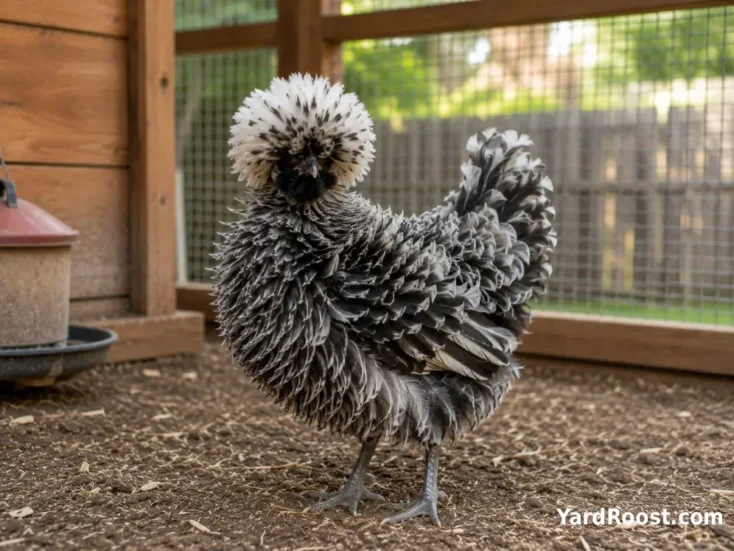
A Polish frizzle chicken is a Polish with feathers that curve outward rather than lying flat. Frizzle describes a feather trait, not a specific Polish color. A frizzle Polish can therefore also be buff laced, Tolbunt, White Crested Black, or another color.
Frizzled feathers offer less protection from rain and can break more readily than normal feathers. These birds benefit from covered outdoor areas, smooth coop surfaces, broad roosts that are easy to reach, and calm flockmates that do not pull damaged feathers.
Responsible breeding matters. The frizzle trait shows incomplete dominance. Breeding a bird with one frizzle gene to another frizzled bird can produce chicks with two copies of the gene. These birds, sometimes called frazzles, may develop excessively curled, brittle feathers and bare skin. Ask Extension recommends pairing a normally frizzled bird with a smooth-feathered bird rather than breeding two frizzles together.
Tolbunt is different: it describes a mottled color pattern rather than feather direction. A Tolbunt Polish chick may change considerably as juvenile feathers are replaced, and color quality can vary widely within a breeding group. Buy from breeders who can discuss health, temperament, parent birds, hatch records, and genetic diversity—not just dramatic coloring.
Common Mistakes to Avoid
Polish chickens are not exceptionally difficult, but small management errors become more noticeable when vision and crest condition are involved.
- Choosing color before health: A rare Tolbunt or frizzle pattern is not more important than bright eyes, normal movement, clean feathers, and responsible breeding.
- Adding one Polish bird to a forceful flock: Introduce birds gradually and watch access to food, water, roosts, and doorways—not just obvious fighting.
- Allowing the crest to stay wet: Correct the waterer setup and provide reliable rain shelter instead of waiting for feathers to dry overnight.
- Assuming a round crest proves a chick is female: Use several physical signs as the bird matures, or buy professionally sexed pullets.
- Expecting commercial-level egg production: Polish hens can be useful layers, but their value also comes from temperament, appearance, and breed conservation.
- Keeping an uncovered run: Limited upward vision can increase vulnerability to aerial predators, while lightweight birds may also fly over low fencing.
Editorial note: The most useful habit is a ten-second head check when you open the coop. Look for two visible eyes, a dry crest, normal posture, and an alert response. That quick routine catches many small problems before they become difficult ones.
When to Get Professional Help
A messy crest can sometimes be corrected through better housing or waterer placement, but illness and injury should not be diagnosed from appearance alone. Move a weak or injured bird to a clean, secure observation area where it can eat and drink without competition, then contact an avian veterinarian, poultry veterinarian, or local extension office.
Seek qualified help promptly when you notice:
- An eye that is swollen, closed, cloudy, injured, or producing discharge
- Bleeding, deep wounds, or repeated attacks to the crest or skull
- Difficulty breathing, persistent nasal discharge, or unusual respiratory sounds
- Loss of balance, inability to locate food or water, or marked weakness
- A sudden decline in eating, drinking, activity, or egg production
- Several birds becoming ill or an unexplained death in the flock
The CDC advises separating new poultry for at least 30 days, using separate equipment where practical, and contacting a veterinarian or extension professional when birds show signs such as reduced appetite, eye or nasal discharge, breathing difficulty, diarrhea, abnormal eggs, or unexpected death.
Wash your hands with soap and running water after touching chickens, eggs, feeders, waterers, bedding, or coop surfaces. Keep dedicated coop shoes outdoors, clean poultry equipment outside the home, and supervise children carefully. Backyard chickens can carry germs even when they appear healthy.
Is a Polish Chicken Right for Your Flock?
A Polish chicken can be a good choice for keepers who enjoy distinctive birds and are willing to pay attention to crest condition, flock dynamics, and predator protection. These chickens are often gentle, entertaining, and capable of providing a steady supply of white eggs without requiring a farm-scale setup.
They are less suitable for a rough free-ranging environment, an uncovered yard with heavy hawk pressure, or a flock dominated by aggressive birds. A keeper who wants maximum egg output with minimal breed-specific maintenance may also be happier with a production-focused layer.
Before purchasing, decide whether you want large fowl or Polish bantam chickens, smooth or frizzle feathers, bearded or non-bearded birds, and a common or project color. Ask the breeder about adult weights, temperament, fertility, sexing method, health history, and whether the birds are bred toward an established exhibition standard.
The crest deserves regular attention, but it should not overshadow the basics: complete feed, dry shelter, ventilation, secure fencing, clean water, and daily observation. Get those details right, and a silver laced Polish hen, Tolbunt Polish rooster, White Crested Black pair, or small group of buff laced Polish hens can become one of the most memorable parts of a backyard flock.