Blue Copper Marans chickens combine slate-blue plumage, warm copper neck feathers, and the dark reddish-brown eggs associated with the Marans breed. They are handsome, substantial birds that can bring something different to a backyard flock without requiring specialized day-to-day care.
You may also see sellers advertise copper blue Maran chickens, Blue Copper Marans, or French Blue Copper Marans. These names usually refer to the same general color pattern, although the quality, leg feathering, egg color, and breeding goals can vary considerably between sellers. The formal breed name is Marans, with the final “s,” whether you are discussing one bird or several.
The biggest point for beginners to understand is that “blue” describes the feathers, not the eggs. These hens lay brown eggs, and the blue plumage gene also means that breeding two blue birds does not produce an entirely blue hatch. Before ordering chicks, it helps to understand those genetics, the breed’s moderate laying ability, and what questions to ask the breeder.
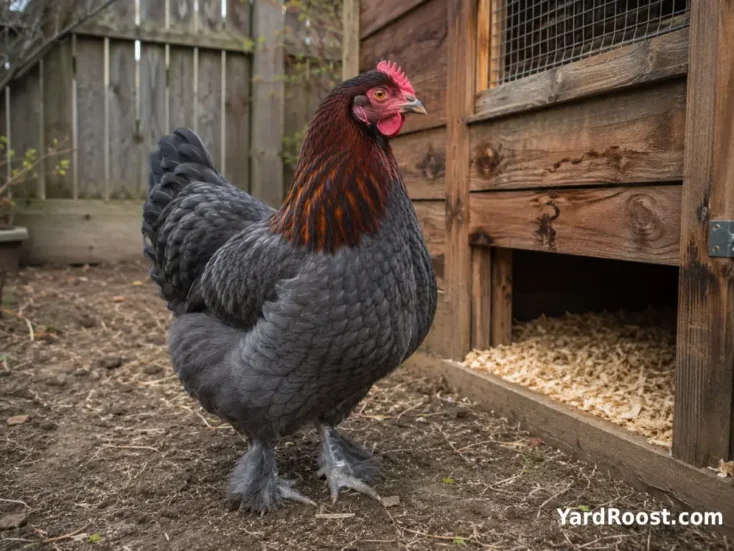
What Are Blue Copper Marans?
Blue Copper Marans are a color variety of the French Marans breed rather than a separate breed. Their black pigment is diluted to blue-gray while the copper-colored areas remain visible, especially around the neck. Roosters generally display more extensive copper coloring across the hackles, shoulders, and saddle than hens.
Marans were developed in France as practical farm birds for both eggs and meat. The breed is especially known for very dark reddish-brown eggs, a broad body, a single comb, and lightly feathered shanks and outer toes. The American Marans standard follows the feather-legged French type rather than the clean-legged type sometimes associated with British breeding.
Blue Copper is not currently included among the American Poultry Association’s accepted Marans varieties. The APA’s current list includes Black, Black Copper, Wheaten, and White Marans. That does not make a Blue Copper bird unhealthy or impure, but it matters when a seller describes birds as APA-recognized or show quality.
Blue Copper Marans Breed Snapshot
The following snapshot reflects the general Marans type. Individual Blue Copper lines may differ because breeders often select for different combinations of body shape, plumage, egg color, and temperament.
| Characteristic | What to Expect |
|---|---|
| Breed | Marans |
| Color Variety | Slate-blue body with copper accents |
| Origin | France |
| Primary Use | Dual-purpose backyard bird |
| Egg Color | Reddish brown to dark chocolate brown |
| Egg Production | Moderate and dependent on the breeding line |
| Comb | Red single comb |
| Legs | Light feathering on the outer shanks and toes in French-standard stock |
| Reference Weight | About 6.5 pounds for hens and 8 pounds for mature roosters |
| APA Status | Marans are recognized, but Blue Copper is not currently an accepted APA variety |
The Marans Chicken Club USA describes the breed as a solid, general-purpose farm bird and gives standard reference weights of 6.5 pounds for hens and 8 pounds for mature males. Those figures are useful for planning housing, but hatchery and breeder lines may finish somewhat lighter or heavier.
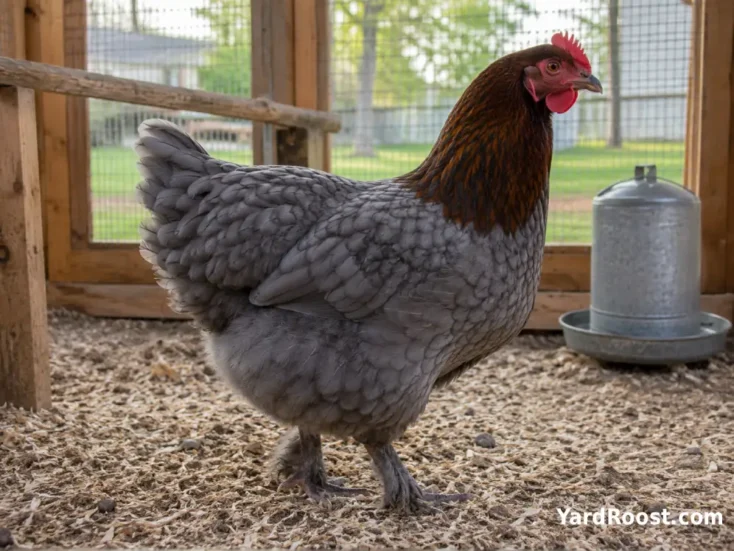
What Blue Copper Plumage Looks Like
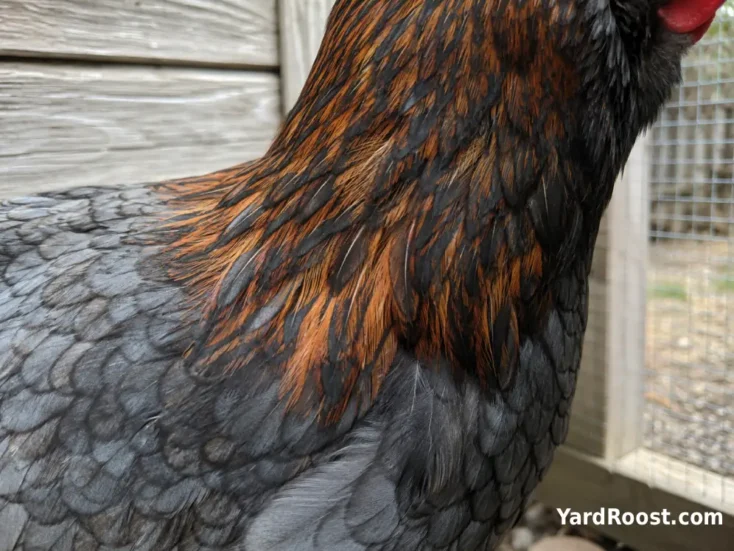
A well-colored Blue Copper Marans chicken typically has a blue-gray body where a Black Copper Marans would have black feathers. The shade can range from pale smoky blue to dark slate, and some birds show noticeably darker edges around individual feathers. Copper coloring is usually most visible around the head and neck of a hen.
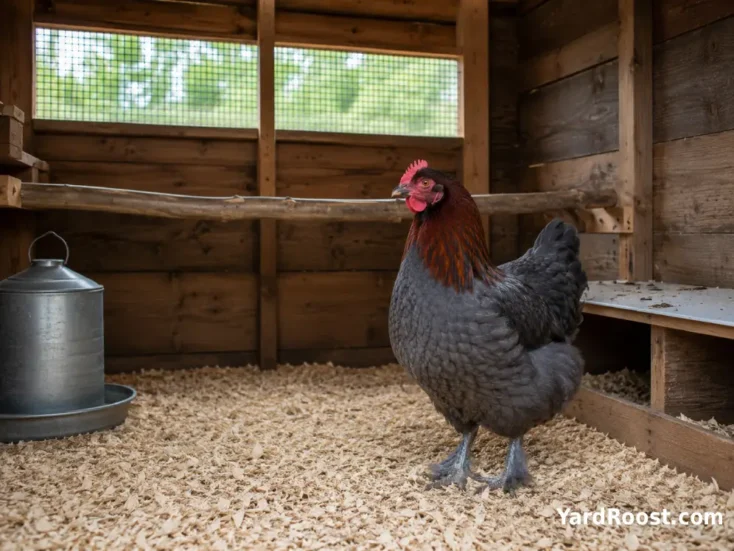
Males are more dramatic. A rooster may have a blue breast and body combined with bright copper or reddish-copper hackles, shoulders, wing bows, and saddle feathers. The exact amount of copper varies, so young birds can change considerably as their adult feathers replace juvenile plumage.
The blue color comes from a gene that dilutes black feather pigment. One copy produces blue plumage, while two copies produce the much paler, irregularly marked color called splash. The copper pigment is controlled separately, which is why the copper portions are not diluted in the same way as the black areas.
Do not expect every backyard-quality bird to match a polished breeder photograph. Too much copper, too little copper, uneven blue, white feathers, or sparse leg feathering can appear even in pure Marans. These details matter greatly to a color breeder but have little effect on whether a hen can live comfortably in a backyard flock.
What Color Eggs Do Blue Copper Marans Lay?
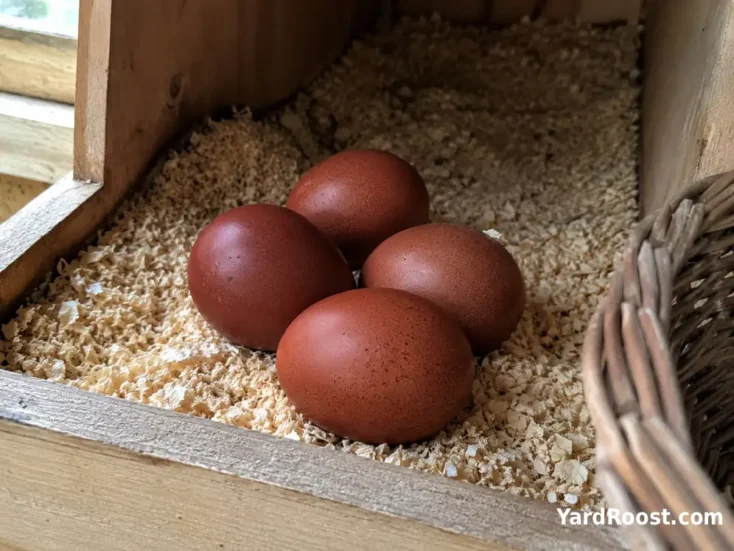
Blue Copper Marans lay brown eggs, not blue eggs. The desirable shells range from reddish brown to deep chocolate or russet brown, sometimes with darker speckles or uneven patches. The Marans breed standard describes the ideal shell as very dark reddish brown.
However, purchasing a blue-feathered hen does not guarantee the darkest possible egg. Brown shell color is influenced by numerous genes, and breeders must select for egg color over generations. A flock bred mainly for attractive plumage may produce lighter eggs than a flock whose breeder consistently selects hens and roosters from dark-egg lines.
Egg shade can also differ between hens in the same pen. For a realistic idea of what you are buying, ask the seller for a recent photograph showing several eggs from the actual parent flock rather than one unusually dark showcase egg. Photographs should be taken in ordinary daylight with no color filter.
- Ask whether the pictured eggs came from the exact breeding pen producing your chicks.
- Look for a group of eggs rather than the darkest single egg.
- Ask whether the breeder selects for egg color, plumage, exhibition traits, or a balance of all three.
- Expect natural differences between individual hens and across laying cycles.
Marans are better viewed as moderate layers of distinctive eggs than as maximum-output production hens. A keeper whose main goal is the highest possible number of eggs may be happier with a commercial laying strain, while a mixed flock owner may value the Marans egg color and substantial body type more. University of Minnesota Extension similarly distinguishes high-production commercial layers from heavier dual-purpose breeds.
Temperament and Mixed-Flock Compatibility
Many Blue Copper Marans settle into backyard flocks as steady, curious birds, but temperament should never be treated as a guaranteed breed feature. The behavior of an individual chicken is affected by its breeding line, early handling, available space, flock composition, and previous experiences.
For a mixed flock, their full-size build usually makes them a more natural match for breeds such as Plymouth Rocks, Orpingtons, Sussex, Wyandottes, and other standard-size hens than for very small or delicate bantams. That does not mean they will automatically bully smaller birds, but large differences in size and confidence can make feeder and roost competition harder to manage.
A practical test is to watch the flock during the busiest times of day. Every bird should be able to approach feed and water without being repeatedly driven away. At dusk, check that less dominant hens can reach a roost rather than sleeping in a nest box or on the floor because another bird blocks them.
Rooster behavior varies even more than hen behavior. Do not buy a straight-run group assuming every extra male will remain quiet or easy to place. Check your local zoning and HOA rules before keeping roosters, and decide in advance how you will manage unexpected cockerels.
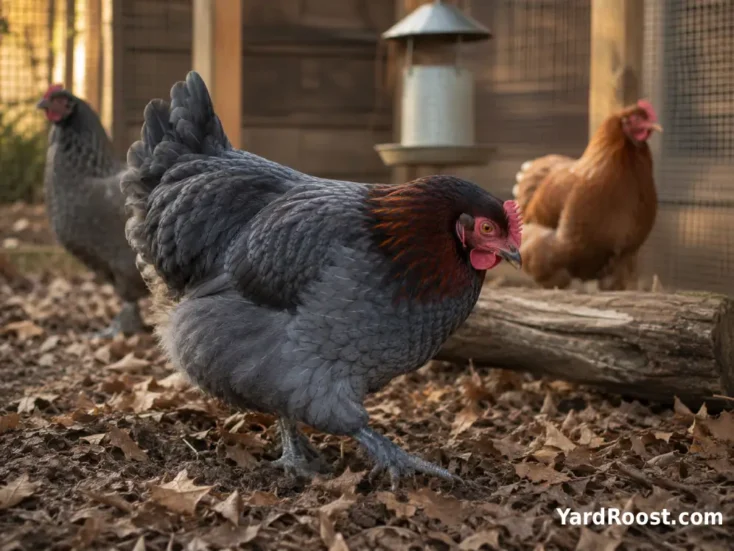
Housing and Everyday Care
Blue Copper Marans do not need a breed-specific coop, but they do benefit from accommodations sized for a substantial standard chicken. University of Minnesota Extension recommends roughly 3 to 5 square feet of indoor space per laying bird. More room can be valuable during bad weather or whenever the flock spends long periods confined.
Use broad, stable roosts that allow these heavier birds to land without colliding with walls, feeders, or other chickens. Avoid arranging a very high roost over a hard floor. A lower, sturdy setup is often easier on full-bodied hens, especially as they age.
- Keep bedding dry enough that it does not clump around the lightly feathered toes.
- Provide shaded outdoor space and more than one water station during hot weather.
- Use a complete feed appropriate for the bird’s age instead of relying on scratch grains or kitchen scraps.
- Check feeder and pop-door openings to make sure broad-bodied adults can pass through without rubbing their backs or wings.
- Inspect leg feathers and toes after long periods of mud, snow, or freezing rain.
Ventilation matters in every season. Fresh-air openings should remove moisture and ammonia without blowing a strong draft directly across roosting birds. Condensation on windows, damp bedding, or a sharp ammonia smell means the coop needs more air exchange, manure removal, or both. University of Maryland Extension recommends using sight and smell as practical ventilation checks.
YardRoost editorial note: Feathered feet are not difficult to manage in a dry run. Trouble usually begins when a frequently used doorway or water station turns into a permanent mud patch. Moving the waterer onto a firm, well-drained base is often more useful than repeatedly cleaning muddy toes.
For more setup guidance, use our Chicken Coop Size Calculator and see our practical guide to chicken coop ventilation.
Raising Blue Copper Marans Chicks
Blue Copper Marans chicks need the same basic brooder management as other standard-size layer or dual-purpose chicks. Prepare the brooder before they arrive, provide a safe heat source, and confirm that every chick can find water and age-appropriate complete starter feed.
University of Minnesota Extension recommends beginning with a brooder temperature of approximately 90°F to 95°F, measured about 2 inches above the floor near the heated area, and lowering it by about 5°F each week as the chicks feather out. Chick behavior should guide adjustments: tightly huddled chicks may be cold, while chicks continually avoiding the heat may be too warm.
- Give chicks room to move freely between warmer and cooler areas.
- Use dry, non-slip bedding such as pine shavings rather than a slick surface.
- Raise waterers slightly as the chicks grow to reduce wet litter.
- Check vents and toes daily for pasted droppings, swelling, injury, or abnormal posture.
- Contact an avian veterinarian or local extension office when a chick is weak, struggling to breathe, unable to stand, or declining despite safe brooder conditions.
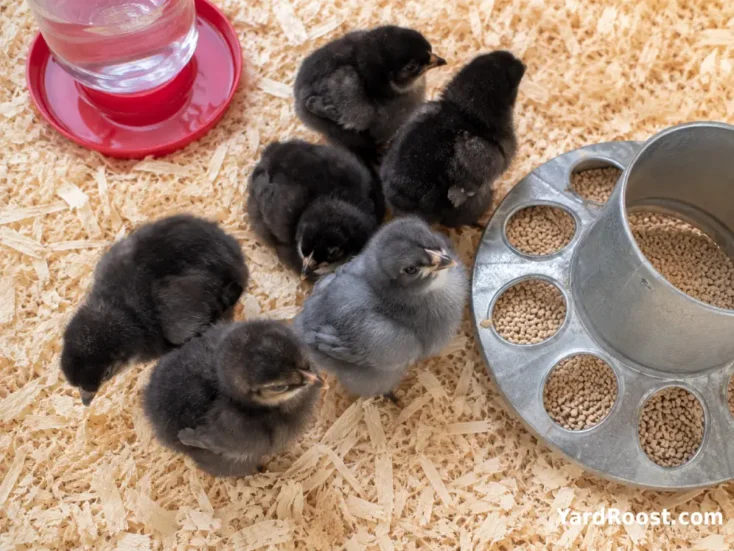
Do not assume Blue Copper Marans chicks can be sexed accurately from their blue, black, or pale down color. Blue plumage is not an automatic sex-linked marker. Ask whether the seller offers professionally sexed pullets, straight-run chicks, or only an estimate based on later development.
Light leg feathering may be visible early, but the amount can change as chicks mature. A chick with sparse toe feathering may grow more later, while a heavily feathered chick is not necessarily a better backyard bird or a darker-egg layer.
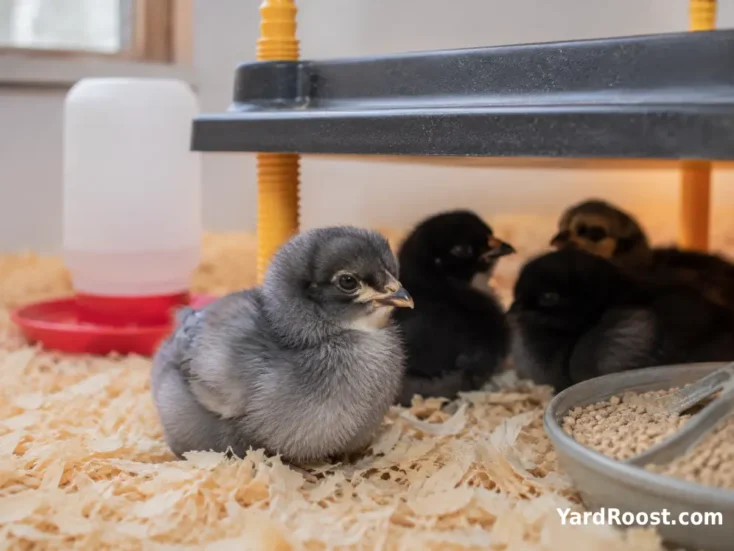
Why Blue Parents Can Produce Black, Blue, or Splash Chicks
The blue plumage gene does not breed true in the everyday sense. A bird with one copy of the gene appears blue. A bird without it appears black in areas governed by black pigment, while a bird with two copies appears splash.
Using the usual blue-gene model, the following outcomes are expected across a large number of chicks. A small backyard hatch can differ substantially from the percentages simply because chance has a larger effect in a small sample. These ratios are an inference from the incomplete-dominant blue gene described by Poultry Extension.
| Parent Pairing | Expected Chick Colors |
|---|---|
| Blue × Blue | About 25% black, 50% blue, and 25% splash |
| Blue × Black | About 50% blue and 50% black |
| Blue × Splash | About 50% blue and 50% splash |
| Black × Splash | Blue chicks expected |
This is why an order of Blue Copper Marans chicks may include black, blue, or splash individuals when it comes from a blue breeding pen. Some hatcheries sell all three outcomes together, while others separate them after hatch.
Color genetics do not guarantee correct copper markings, body shape, leg feathering, temperament, or dark eggs. Those traits require separate selection. A breeder can understand blue genetics perfectly and still produce birds whose egg color is lighter than you expected.
How to Choose Chicks or Breeding Stock
The quality of the seller matters more than an impressive color description. Listings for French Blue Copper Marans chickens commonly imply the lightly feathered French-standard leg type, but the word “French” alone does not prove careful breeding, dark eggs, or exhibition-quality conformation.
Ask direct questions before placing an order:
- Are the chicks sold as pullets, straight run, or unsexed?
- Which colors can hatch from the breeding pen?
- Do the parent birds have lightly feathered shanks and outer toes?
- Can the seller provide recent egg photographs from that exact pen?
- Is the breeding goal egg color, plumage, body type, or a practical balance?
- What health guarantee or arrival policy applies to shipped chicks?
Be careful with the phrase “show quality.” Because Blue Copper is not currently an APA-accepted Marans variety, ask which organization or proposed standard the breeder follows and what “show quality” means in that listing. The birds may still be thoughtfully bred, but the description should be specific rather than promotional.
When purchasing started birds or adults, plan a separate quarantine area before bringing them home. USDA APHIS recommends quarantining new additions for 30 days and checking daily for respiratory signs, swollen eyes, mites, lice, and other health concerns before exposing the resident flock.
Choose a breeder who is comfortable discussing weaknesses as well as strengths. An honest answer such as “our line has excellent egg color but variable copper” is more useful than a claim that every chick will mature into a perfect bird.
Common Mistakes to Avoid
- Expecting blue eggs: The blue name refers to feather color. Marans eggs are brown.
- Expecting every chick to be blue: Blue-to-blue matings can produce black, blue, and splash chicks.
- Judging egg potential by plumage alone: Attractive copper and blue feathers do not prove that a line lays especially dark eggs.
- Ignoring the final “s” in Marans: Informal listings often say Maran, but Marans is the formal breed name.
- Assuming French means fully standardized: Confirm leg feathering, breeding goals, and parent-flock quality rather than relying on the label.
- Keeping feathered feet in constant mud: Improve drainage near doors and waterers before mud becomes a daily maintenance problem.
- Overcrowding a full-size bird: Plan housing for mature body size, not the space occupied by young pullets.
- Skipping quarantine for adult purchases: A bird that appears healthy at pickup can still introduce parasites or infectious disease.
Another common mistake is buying solely from a dramatically dark egg photograph. Lighting, editing, and selective photography can make one egg look representative of an entire line. A group photograph of ordinary eggs from the current breeding pen gives you a better basis for comparison.
Are Blue Copper Marans Right for Your Flock?
Blue Copper Marans can be a rewarding choice for keepers who want a substantial chicken, richly colored eggs, and unusual plumage. They fit especially well in a varied backyard flock where egg-basket color matters more than producing the largest possible number of eggs.
They may suit your flock when you:
- Enjoy dark brown eggs but understand that shade varies by breeding line.
- Have enough coop and run space for full-size chickens.
- Can keep feathered feet reasonably dry.
- Do not mind black or splash chicks appearing in a breeding program.
- Value appearance, foraging behavior, and traditional dual-purpose type.
Consider another breed or strain when your first priority is maximum egg production, guaranteed uniform chick color, clean legs for persistently muddy conditions, or an APA-recognized blue exhibition variety.
For families seeking highly interactive pet chickens, buy from a seller who selects for temperament and handles chicks regularly. Breed labels can provide a useful starting point, but the breeder’s line and the bird’s individual personality are better predictors of how comfortable it will become around people.
Final Thoughts on Blue Copper Marans Chickens
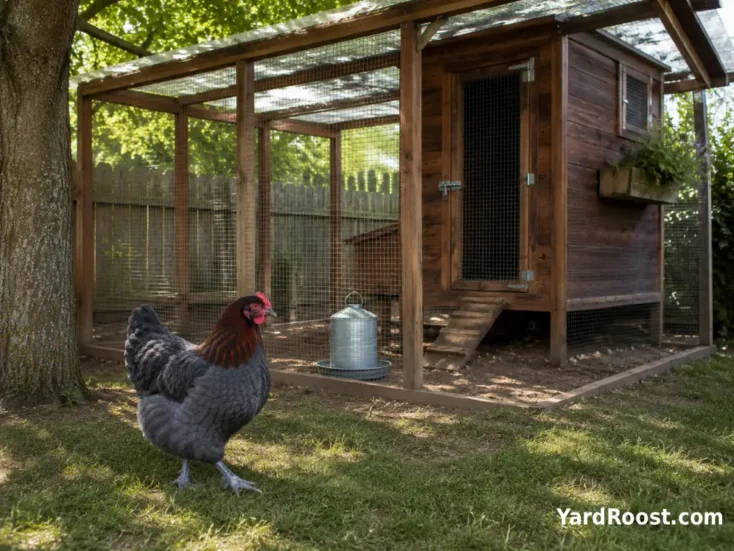
Blue Copper Marans offer more than an attractive feather pattern. They are sturdy, full-size chickens with traditional farm-bird character and the potential to add deep reddish-brown eggs to a mixed basket. Their everyday care is straightforward, provided they receive adequate space, balanced feed, dry footing, predator-secure housing, and good ventilation.
The main buying challenge is variation. Not every Blue Copper bird has the same shade of blue, the same amount of copper, or the same potential for dark eggs. Blue breeding pens can also hatch black and splash chicks. Those differences are normal genetics rather than evidence that something went wrong.
Choose the source as carefully as the color. Ask to see the parent birds and several recent eggs, confirm whether chicks are sexed, and understand what the breeder prioritizes. With realistic expectations and a well-prepared coop, Blue Copper Marans can become a distinctive and practical part of a small backyard flock.