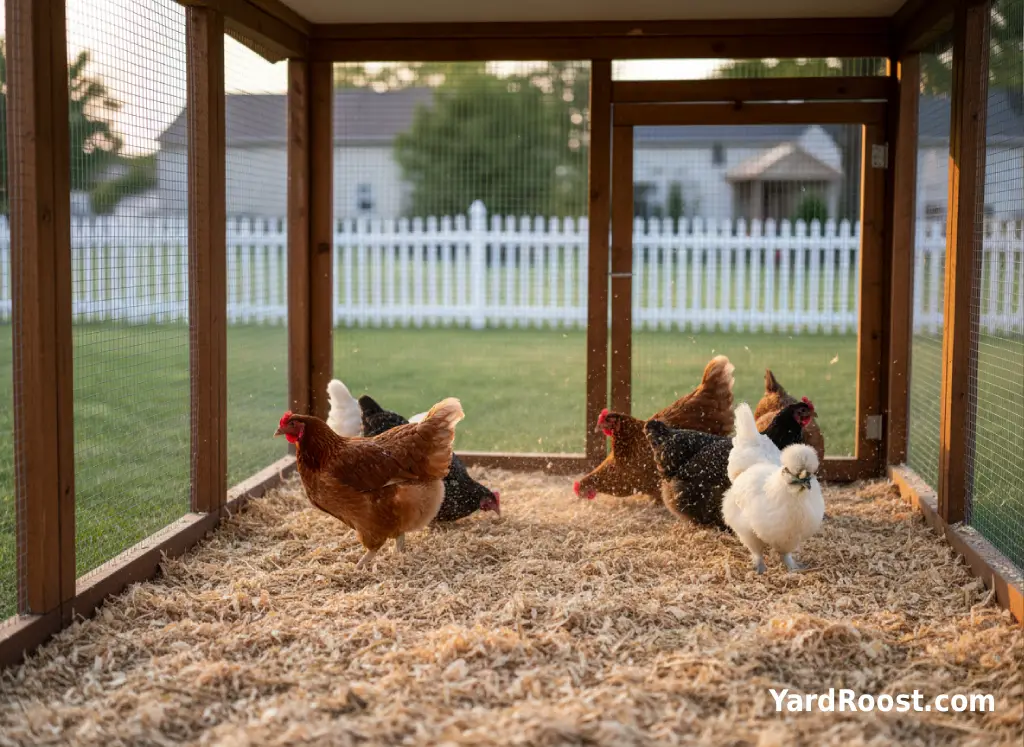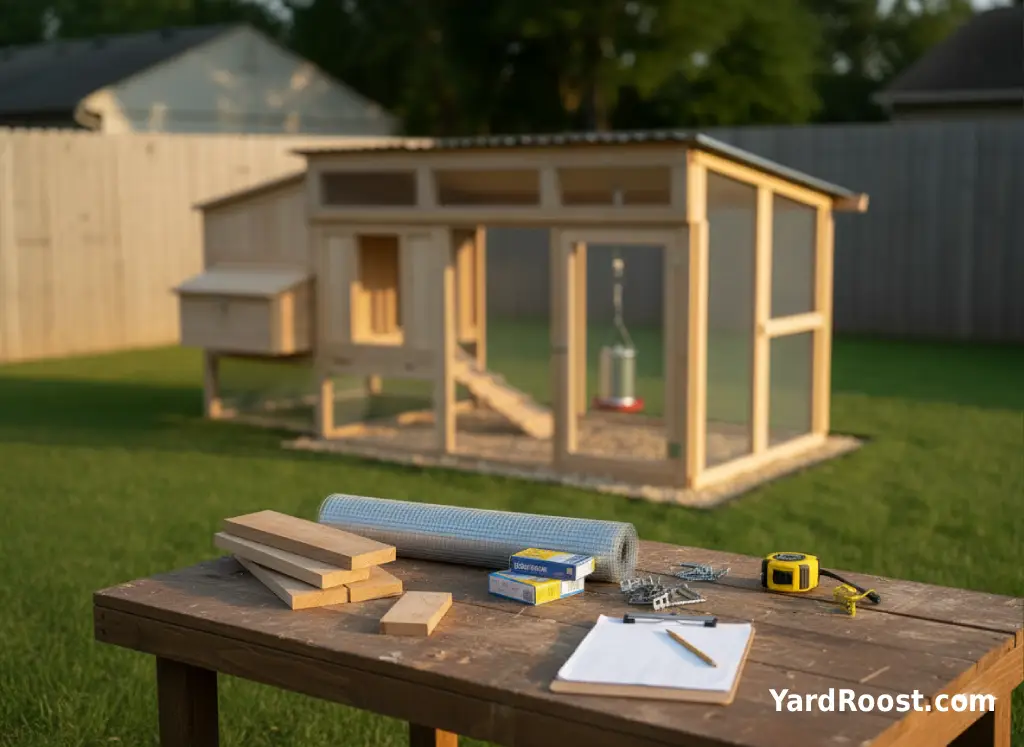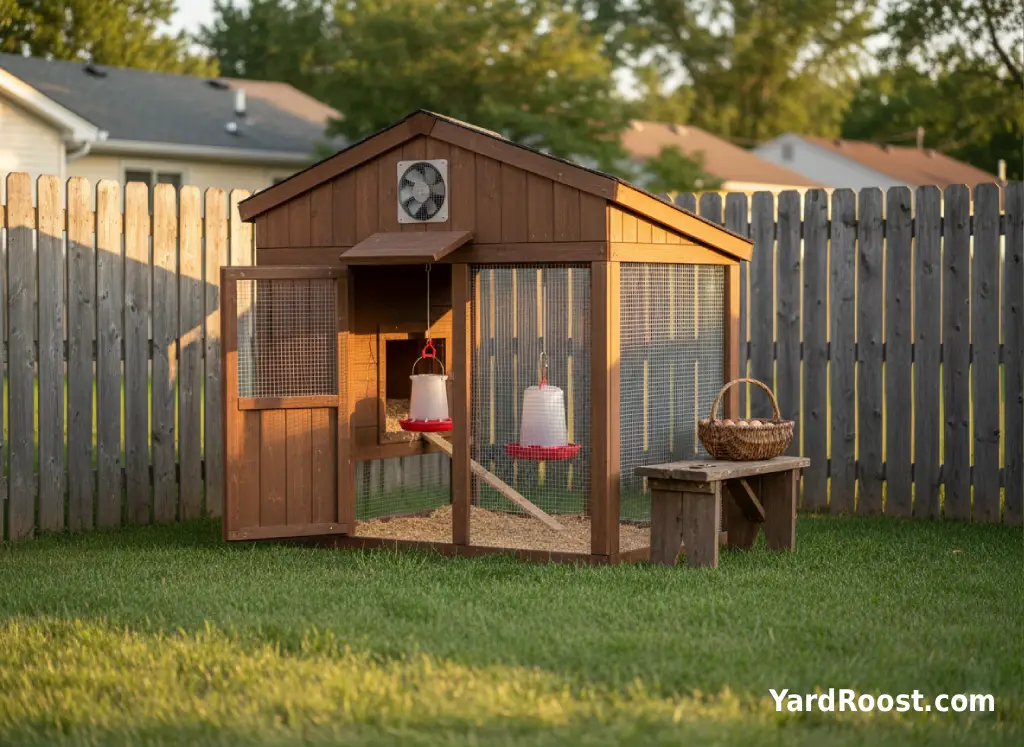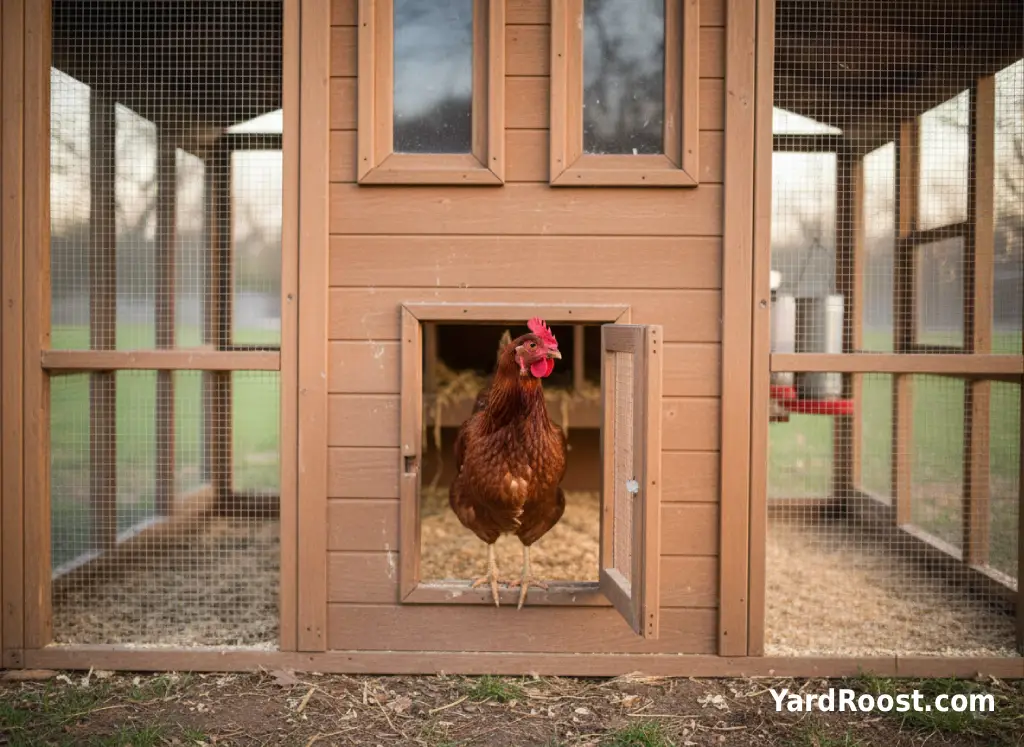
A chicken wire fence is one of the simplest ways to keep curious hens away from seedlings, divide a backyard, or create a temporary daytime poultry area. It is inexpensive compared with many rigid fence systems, easy to cut, and light enough for a weekend project. But it has an important limit: ordinary hexagonal chicken wire is designed mainly for containment, not serious predator protection.
That distinction changes what you should buy and where you should install it. A low chicken wire garden fence might protect lettuce from scratching feet, while the same lightweight mesh is a poor choice for an unattended chicken run. If a fox, raccoon, loose dog, or digging predator can reach your birds, invest in stronger barriers instead.
Here is how to choose the right fence height and wire, work out how many rolls you need, build a practical garden enclosure, and recognize when a proper predator-resistant run is the safer project.
When Is Chicken Wire the Right Fencing Material?
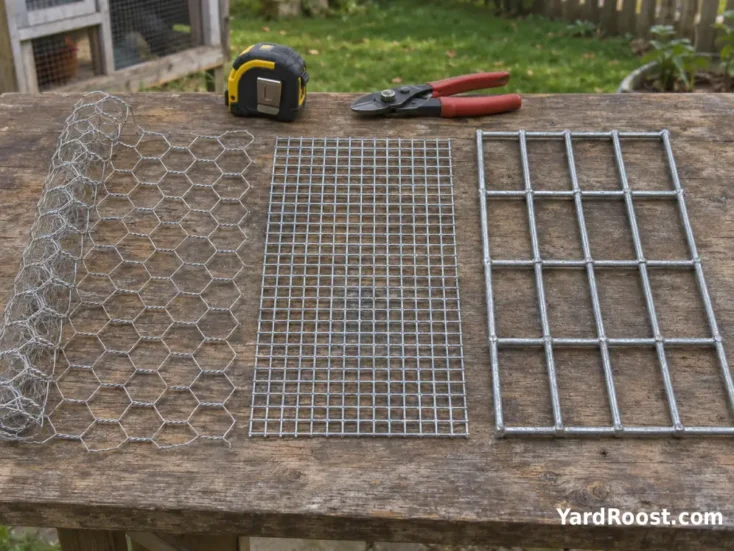
Traditional chicken wire is thin wire twisted into a flexible hexagonal pattern. You may see it sold as poultry netting, chicken fence wire, or hex mesh. Rolls commonly have 1-inch or 2-inch openings and come in several widths. The open pattern is useful around plants because sunlight and rain pass through it, and the fence can be removed or moved without dismantling a heavy structure.
It is a good fit for three everyday jobs: keeping adult hens out of garden beds, separating a supervised portion of the yard, and protecting young plants with removable mesh covers. It is less suitable around chicks, which can slip through larger openings, and unsuitable as the primary barrier where animals may force their way in.
Utah State University Extension cautions that chicken wire is not a predator barrier: animals may tear through it or squeeze through the openings. Think of it as a boundary that directs chicken traffic, not as a secure wall. A flock still needs a solid, lockable nighttime coop and a properly protected run when unsupervised.
Chicken Wire vs. Hardware Cloth vs. Welded Wire
These materials are often grouped together in stores, but they do very different jobs. Hardware cloth is a stiff, welded grid with small openings; the name does not mean fabric. Welded-wire fencing has stronger, typically larger openings and can work as the structural layer of a run, with finer mesh added where animals might reach through.
| Material | Best Use | Main Limitation |
|---|---|---|
| Hexagonal chicken wire | Garden beds and supervised daytime boundaries | Easy for determined predators to damage; openings can allow access |
| 1/2-inch galvanized hardware cloth | Coop vents, vulnerable run walls, gates, and lower perimeter | Costs more and takes more effort to cut and fasten |
| Heavy welded-wire fencing | Structural enclosure walls and larger runs | Large openings may still allow reach-through or small animals |
| Electric poultry netting | Movable daytime pasture boundaries with proper equipment | Needs the correct energizer, grounding, upkeep, and safe installation |
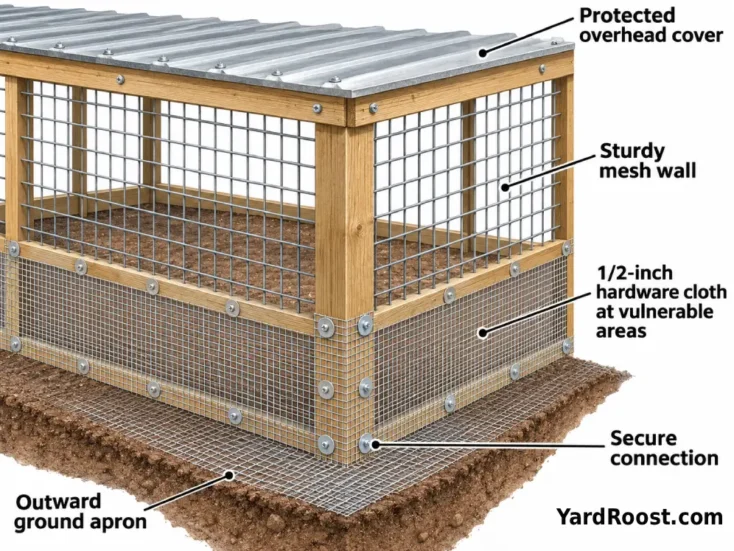
For a predator-exposed chicken coop fence, use robust framing, small-opening galvanized hardware cloth in vulnerable areas, suitable fasteners, a protected top, and a dig-resistant base. If you use larger welded wire for strength, add smaller mesh where predators can reach birds. The University of New Hampshire Extension recommends openings smaller than 1 inch for poultry enclosures to reduce reach-through risk.
For a complete run rather than a vegetable-bed divider, our guide to building a secure chicken run covers framing, gates, drainage, and overhead protection.
How Tall Should a Chicken Fence Be?
The right height depends on what you are trying to keep apart. A fence around vegetables does not have the same job as one enclosing a full chicken run. Lighter breeds, young pullets, and motivated birds can fly or hop higher than a keeper expects. A compost bin or garden bench near the edge can act as a launching point.
| Fence Job | Practical Starting Point | What to Check |
|---|---|---|
| Raised-bed or crop protection | About 2–3 feet for a simple barrier | Are hens reaching over, hopping in, or finding an open gate? |
| Daytime adult-chicken boundary | About 4–6 feet, adjusted for the flock | Do lighter birds clear it, or use nearby objects to launch? |
| Unsupervised or predator-exposed run | Secure, fully enclosed design rather than height alone | Are the top, lower edge, gate, and all seams protected? |
These are planning ranges, not escape-proof guarantees. A 3-foot garden barrier may be enough for heavy, uninterested hens, yet fail with athletic birds. A 6-foot open-top run can still be entered by climbing predators. Colorado State University Extension warns that coyotes and bobcats can clear 4-foot fencing; a secure roof or overhead barrier matters.
Before buying more height, move perches, woodpiles, raised planters, and bins away from the fence line. If hens repeatedly leave the area, read our guide to why chickens fly over fences and address both the launch points and the boundary itself.
How to Build a DIY Chicken Wire Garden Fence
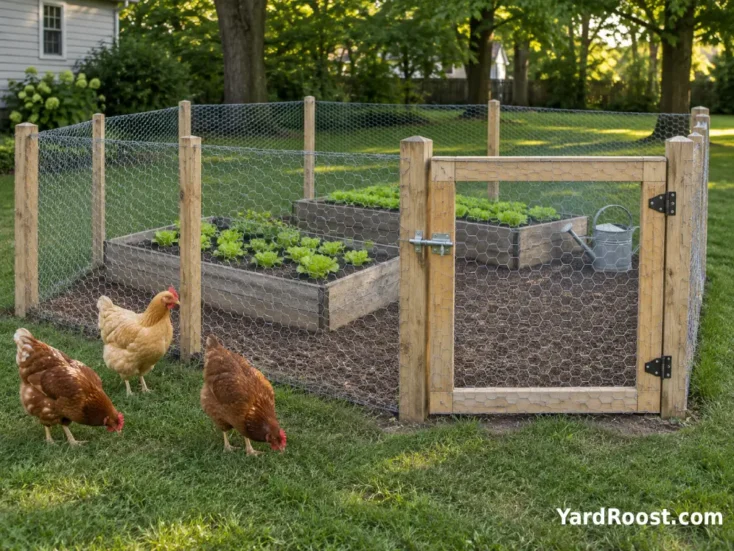
This build is for protecting a vegetable plot from your own chickens or making a temporary supervised partition. It is not a plan for predator-proof overnight housing. For a permanent run, substitute the stronger construction discussed above.
Tools and Materials
- Galvanized chicken wire, commonly 1-inch hex mesh, in a width matching your planned height
- Sturdy wooden posts or suitable metal T-posts, plus stronger corner and gate supports
- Post-hole digger or post driver, stakes, string, tape measure, and level
- Galvanized poultry staples for wood or appropriate metal-post clips and ties
- Wire snips, protective gloves, safety glasses, and pliers
- Optional top and bottom rails, tension wire, ground pins, and a simple access gate
Six Steps for a Neat, Practical Fence
- Mark the boundary. Run string around the garden, mark the corners, and decide exactly where you will walk in. Allow enough gate width for a bucket or wheelbarrow.
- Set the posts. Install corners and gateposts first. For a simple lightweight fence, posts roughly 6–8 feet apart are a useful starting layout; shorten spans on uneven ground or wherever the mesh sags. Set posts to a depth suitable for their height, soil, and local frost conditions.
- Add support if needed. A top rail or properly tensioned support wire helps prevent drooping. Add a bottom rail when you need a tidy, consistently low edge.
- Unroll the wire safely. Put on gloves and eye protection. Lay the roll on a flat surface, control its springing end, and release the binding wires gradually. Have a helper hold the roll while you bring the first edge to a post.
- Fasten and overlap. Secure the first edge, then pull the material snug by hand toward the next post without distorting the hexagons. Fasten it frequently to posts and rails, overlap adjoining pieces by several inches, and secure the seam rather than leaving a loose flap.
- Finish the base and gate. Pin the lower edge tight to the ground if your goal is to stop hens ducking under. Check that the gate closes completely, fold or cover sharp wire ends, and walk the entire fence line looking for gaps.
YardRoost note: The most common garden-fence failure is not a hen flying over it. It is a loose bottom corner where two panels meet, or a gate that gets left open because it is awkward to use. Make the gate convenient and inspect the bottom edge before adding another foot of height.
How Much Chicken Wire Do You Need?
Measure the entire perimeter, subtract any gate opening you are not covering with the roll, and add material for overlaps, corners, and cutting errors. Roll width determines fence height; roll length determines how much perimeter you can cover. A 48-inch-by-50-foot roll is 4 feet tall and 50 feet long, not 50 feet of 4-foot wire after overlaps and trimming.
For example, a rectangular garden measuring 12 by 18 feet has a 60-foot perimeter: 12 + 18 + 12 + 18. If you build a 3-foot-wide gate and cover its frame with separate material, the main fence needs about 57 linear feet before extra allowances. One 50-foot roll will not be enough; choose a longer roll or buy a second one. When planning two adjoining runs of mesh, include extra length for the overlap.
If you are calculating a permanent run, remember that the sides are only part of the order. A secure overhead structure, gate, lower hardware cloth, and ground apron add separate material requirements. Sketch each section before shopping instead of assuming one long roll covers everything.
How Much Is a Roll of Chicken Wire?
Price depends on width, roll length, gauge, opening size, coating, and retailer. As a November 2026 US retail snapshot, common 1-inch hex mesh in 50-foot rolls was listed at roughly $27 for 24-inch height, around $38–$50 for 36-inch height, and roughly $40–$70 for many 48-inch options at major home and farm retailers. Brand and local availability can move prices considerably; taller, coated, or longer rolls may cost more.
Compare the same dimensions rather than just the sticker price. Divide the roll price by its length for the cost per linear foot, then add posts, fasteners, gate hardware, supports, and waste. A $50 roll covering 50 feet costs $1 per linear foot for mesh alone. It is not the total installed fence cost.
Home Depot, farm supply stores, hardware stores, and fencing suppliers commonly carry 25-, 50-, and 150-foot rolls; actual inventory varies by store. For a chicken enclosure, factor in the higher cost of hardware cloth or heavy welded wire before deciding a cheap roll will save money. A bargain that fails as a predator barrier is not economical.
Keeping Chickens Out of the Vegetable Garden
Free-ranging hens do not recognize the difference between a weed patch and a row of carefully planted seedlings. They scratch, dust bathe, and investigate soft soil, especially right after you weed or water. Protecting the beds is often easier than trying to retrain every bird.
A garden chicken wire fence works best when it completely surrounds the vulnerable space and has a gate you will reliably close. Keep it a little away from tall trellises or stacked pots that make easy jumping platforms. If hens push under the mesh, secure the bottom along the entire span rather than adding scattered rocks that leave gaps between them.
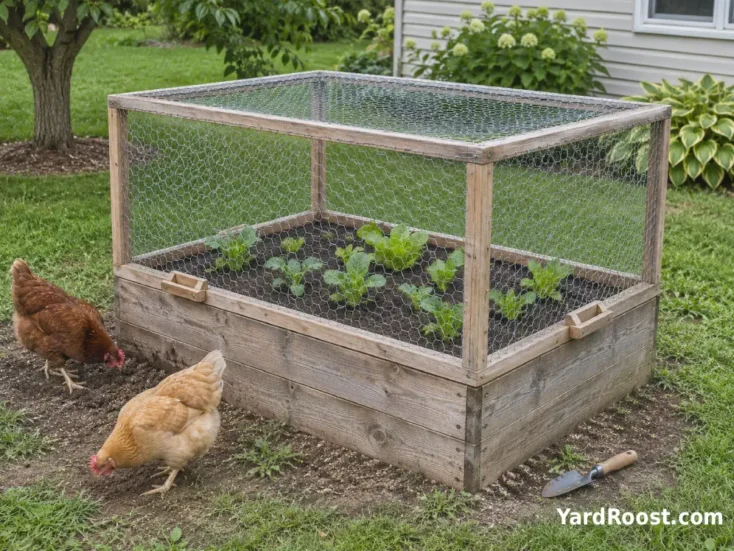
For smaller patches, use a removable framed mesh lid or a chicken wire crop coop—a lightweight protective cage placed over seedlings—as an alternative to fencing the whole garden. These covers must be tall enough for the plants to grow, easy to lift for weeding, and firmly anchored so wind cannot tip them. For example, Gardener’s Supply Company’s Chicken Wire Crop Coop has a peaked shape designed to cover a 2-by-4-foot bed, with about 28 inches of center height. Check current dimensions and anchoring options for any purchased cover. Even a sturdy plant protector is not a substitute for secure chicken housing.
Can You Keep Chickens Out Without a Fence?
You can reduce damage without fencing every bed, but no unfenced method is dependable for an unsupervised flock. Try a dedicated scratching and dust-bathing area away from crops, supervised garden access after harvest, mulch or plant covers around sensitive seedlings, and redirecting birds to a more interesting area of the yard. Repeatedly chasing them away usually works only while you are present.
If vegetables are frequently destroyed, prioritize a physical plant barrier. For young leaves and freshly turned beds, a small, properly anchored mesh cover is a more predictable solution than scents, ornaments, or supposed chicken-repelling plants.
How to Make a Chicken Run Fence Safer Against Predators
A garden boundary and a chicken run are not interchangeable. Chicken wire is flexible enough to be pulled or torn, and some animals can bite through or reach through it. Utah State University Extension recommends small woven hardware cloth for stronger exclusion; University of New Hampshire Extension emphasizes secure enclosures and overnight lockup.
Start with the lowest and weakest parts of the enclosure, not just the tallest wall. A fox or dog may dig, a raccoon may pull at a gate, and a small predator may exploit a seam that looks insignificant from a distance. The right defense is a combination of materials and details:
- Reinforce vulnerable surfaces. Use securely attached 1/2-inch galvanized hardware cloth on lower walls, vents, gates, and reach-through areas. Attach with screws and washers or appropriate battens, not a few light staples.
- Block digging. Install a durable wire barrier below ground, or a securely connected outward-facing hardware-cloth apron at the fence base. University poultry-extension guidance describes burial around 12 inches deep as one option. Adapt the installation to soil and predator conditions.
- Close the top. A roof or strong overhead barrier helps stop climbing and aerial entry. Lightweight bird netting may discourage hawks but should not be treated as protection from all climbing mammals.
- Fix the gate. Keep gaps small, reinforce corners, and use a latch that a curious animal cannot flip open with one motion.
- Lock the flock inside at night. Shut chickens in a sturdy coop with secured doors and screened openings before dark, even if the daytime run looks substantial.
A raccoon does not need to climb into an enclosure to injure a bird if it can reach through large openings. Our guide to raccoons and chicken protection explains the reach-through problem and ways to strengthen doors and walls.
For overhead decisions, use the separate guide to chicken run covers and roofing. Shade cloth, rain tarps, and predator-resistant overhead wire each solve a different problem; one material rarely does all three.
Common Mistakes to Avoid
Most fence troubles show up at corners, seams, and the ground rather than in the middle of a neatly stretched panel. Check these details before your chickens find them for you.
- Calling a mesh panel predator-proof because it is six feet high. Height alone does not stop digging, climbing, chewing, or reach-through.
- Using a single loose span without support. Add posts or rails when the fence bows outward or the lower edge can be lifted easily.
- Choosing 2-inch openings for young chicks. Small birds may fit through gaps intended only to hold adult hens.
- Cutting wire without gloves or leaving exposed ends. Trim and fold back sharp edges; keep loose clippings out of the run and garden.
- Forgetting the gate. A beautiful perimeter is not useful when the gate sags, drags, or fails to latch.
After storms, freezing weather, or any sign of digging, look for rust, bent mesh, pulled staples, loose clips, and gaps around the bottom rail. Replace damaged predator-barrier material rather than patching a large failure with more thin chicken wire.
When to Get Professional Help
Consider a qualified fence installer or local extension office when you are enclosing a large yard, dealing with repeated predator intrusions, building on a steep slope, or anchoring heavy gates and roof framing. Check municipal setbacks, permit requirements, and HOA rules before installing a permanent perimeter fence. Local conditions and rules vary.
If a bird is injured after an escape or attack, move the flock to a secure, quiet area without delaying needed care, and contact an avian or poultry veterinarian for significant wounds, bleeding, breathing problems, or abnormal behavior. Fix the entry point before returning birds to the enclosure.
Questions Backyard Keepers Often Ask
Can Chicken Wire Keep Foxes, Raccoons, or Dogs Out?
No, not reliably. Thin hex mesh is intended mainly to contain chickens or protect plants. For predators, choose a properly framed enclosure with stronger small-opening mesh, a dig-resistant base, protected top, secure gates, and a locked nighttime coop.
Can You Extend an Existing Chicken Run?
Yes. Start with structurally sound posts, matching mesh and support strength, a secure connection to the original frame, and no open seam at the old-new junction. If the original run uses weak poultry netting, do not copy that weakness into the extension. Plan roof and dig protection for the added area, too.
What Is the Easiest Way to Open a Roll of Chicken Wire?
Set it on level ground, wear protective gloves and eye protection, and keep one hand or a helper on the loose end as you cut each retaining tie. Unroll a few feet at a time; do not release the whole spring-loaded roll beside pets, children, or chickens.
Is Plastic Chicken Fencing a Good Alternative?
Plastic mesh can separate a supervised garden area or support a lightweight plant cover, but it is not a secure run wall. It can stretch, deteriorate outdoors, and be damaged by chewing or pulling. Use metal barriers where animal safety depends on the fence.
Choose the Fence for the Job
A chicken wire fence earns its place around vegetable beds, temporary partitions, and lightweight crop covers. Keep the lower edge tight, make the gate easy to use, and adjust the height to your particular birds instead of relying on a fixed rule. It is a straightforward DIY project when the goal is keeping hens from scratching up the lettuce.
For an actual chicken coop and run, make a different purchasing decision. Spend the money on strong mesh, dependable framing, secure fastening, a protected top, and a barrier against digging. Those details matter far more to flock safety than the label on a roll of wire.
Before the next shopping trip, measure your garden or run, sketch where the gate will go, and decide whether you need simple containment or genuine predator resistance. That one decision will save the most wasted materials—and give your hens a safer place to spend their day.
Sources consulted for safety guidance: Utah State University Extension; University of New Hampshire Cooperative Extension; Colorado State University Extension; University of Kentucky/Poultry Extension; Penn State Extension; University of Georgia Cooperative Extension.